What Is Liquid Staking and How Do LSTs Work? (2026)
What Is Liquid Staking and How Do LSTs Work? (2026)

What Is Liquid Staking and How Do LSTs Work? (2026)
What Is Liquid Staking and How Do LSTs Work? (2026)
Updated March 4, 2026 · 8 min read
TL;DR
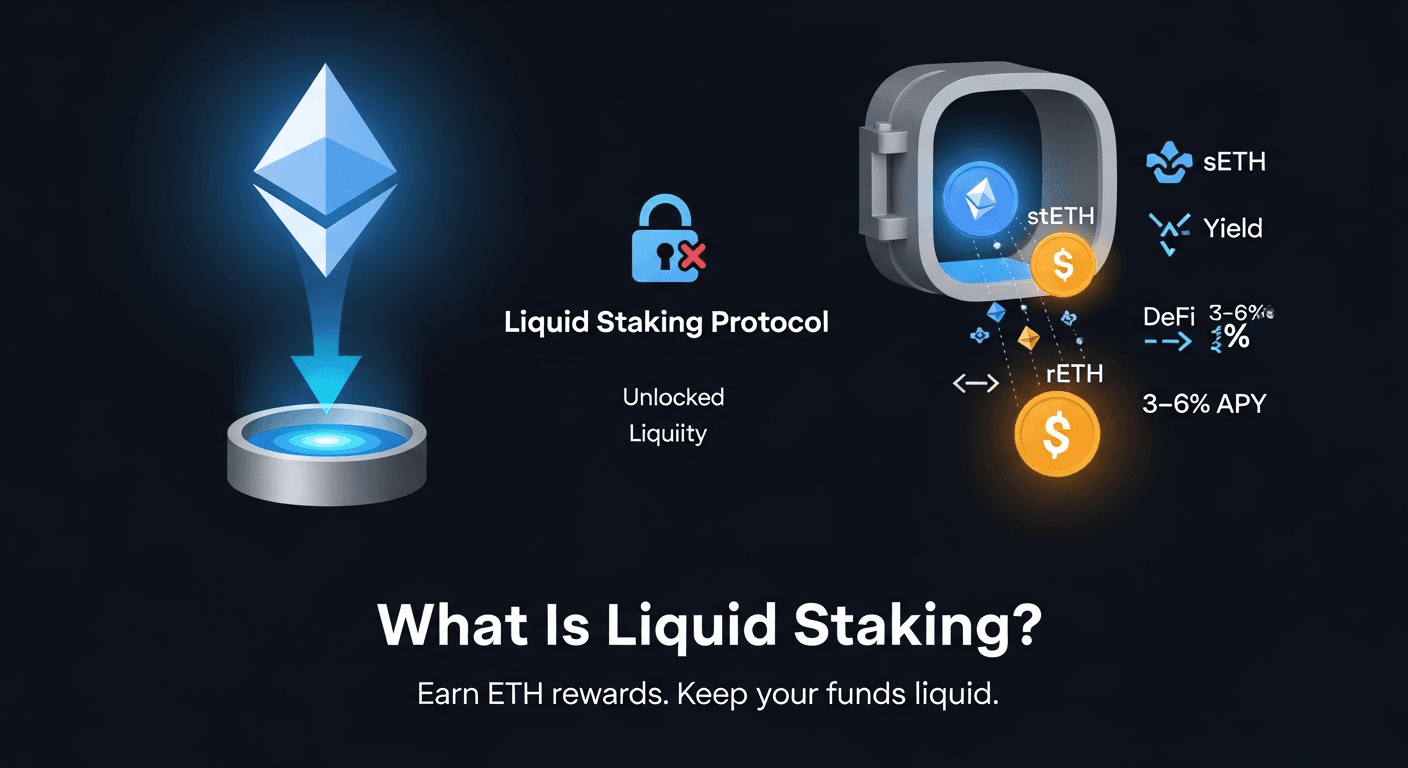
Liquid staking lets you earn Ethereum staking rewards without locking up your ETH. You deposit through a protocol, receive a tradeable token (stETH, rETH) representing your staked position, and that token works across DeFi while your ETH earns 3–6% APY. Over $66 billion sits in liquid staking protocols as of early 2026. If you'd rather go direct, Lido is the largest single option at $27.5B TVL. For anyone who wants curated vault access with risk grades across multiple protocols, aggregator platforms are worth comparing.
Key takeaways
Liquid staking keeps your ETH usable. You stake, get an LST back, and can use that token in DeFi while rewards keep accruing.
No 32 ETH minimum. Most protocols accept any amount, which is the main practical difference from running your own validator.
Lido (stETH) and Rocket Pool (rETH) together control most of the $66B+ market. They work differently but both are battle-tested.
Three real risks to know: smart contract bugs, LST depegging in stressed markets, and slashing if a validator misbehaves.
The SEC clarified in August 2025 that most LSTs are not securities, which removed a major blocker for institutional capital.
The problem that liquid staking was built to solve
Ethereum switched to proof-of-stake in September 2022. Under proof-of-stake, validators lock up ETH as collateral, a security deposit that keeps them honest. If a validator cheats or goes offline too often, some of that deposit gets slashed.
The mechanics work, but for everyday holders they create a real headache. You need 32 ETH to run your own validator (roughly $80,000–$100,000 at current prices), the process is technically involved, and once you stake, your ETH is tied up. You can't sell during a market swing. You can't use it as loan collateral. It just sits there earning rewards while you watch the market.
That's the gap liquid staking fills.
What liquid staking actually is
Liquid staking protocols pool ETH from many depositors, run the validator nodes on your behalf, and give you back a receipt token called a liquid staking token (LST) that represents your position. That token moves with you. You can trade it, lend it, use it as collateral, or route it through other DeFi protocols, all while the underlying ETH keeps earning staking rewards.
The yield accumulates in one of two ways depending on the protocol:
Rebasing tokens (like stETH from Lido) increase your wallet balance over time. You hold 10 stETH today; in a year, your balance might show 10.35 stETH. The rewards are built into the token count.
Value-accruing tokens (like rETH from Rocket Pool, or wstETH) keep the token count flat, but each token becomes worth more ETH as rewards accumulate.
Both accomplish the same thing. The difference is accounting: rebasing tokens are easier to read intuitively; value-accruing tokens are generally cleaner for DeFi composability.
How it works, step by step
Here's what happens when you deposit 1 ETH into a liquid staking protocol:
You connect a wallet and deposit ETH into the protocol's smart contract.
The protocol pools your ETH with other depositors and runs Ethereum validator nodes.
You receive an LST in return: 1 stETH, or an equivalent amount of rETH.
Your LST starts accruing value from staking rewards, currently 3–6% APY on Ethereum.
You can deploy that LST elsewhere, lend it, add it to a liquidity pool, or just hold it.
When you want out, you burn the LST and receive your original ETH plus accumulated rewards.
That last step, burning and redeeming, has a delay. Ethereum's exit queue means you might wait a few days to a few weeks to get native ETH back. Most users who need liquidity immediately sell their LST on a secondary market instead.
The major liquid staking protocols
The market is highly concentrated. Two protocols dominate:
Protocol | Token | TVL (early 2026) | APR (approx) | Min. stake |
|---|---|---|---|---|
Lido | stETH / wstETH | ~$27.5B | ~3.5–4% | Any amount |
Rocket Pool | rETH | ~$1.7B | ~2.4–3.3% | 0.01 ETH |
Frax | sfrxETH | ~$500M | ~3–4.5% | Any amount |
StakeWise | osETH | ~$400M | ~3.5–4% | Any amount |
Lido holds around 24% of all staked ETH. That concentration has drawn criticism about validator centralization on Ethereum. Rocket Pool was built to address this: it uses a permissionless node operator model where anyone with 8 ETH can run a validator, distributing control more broadly.
Both are heavily audited and have run without a major exploit since launch. That track record matters when you're evaluating risk.
Liquid staking vs. traditional staking
The tradeoffs break down like this:
Native staking | Liquid staking | |
|---|---|---|
Minimum ETH | 32 ETH | Any amount |
Technical setup | Required | None |
Liquidity | Locked until exit queue clears | LST is transferable and usable |
Smart contract risk | Lower | Higher (additional contract layer) |
Yield | ~3.5–4.5% APY | ~3–4% APY (fees apply) |
DeFi composability | None | High (lending, DEXs, vaults) |
Native staking gives slightly higher yields because there's no protocol fee, and the smart contract risk is lower since you're interacting directly with Ethereum's consensus layer. But the 32 ETH minimum is a real barrier for most people, and your position is illiquid by default.
For the majority of ETH holders, liquid staking is the practical choice. You give up a small fraction of yield in exchange for flexibility and the ability to put your position to work elsewhere.
How people actually use liquid staking tokens
Holding an LST and waiting isn't the only play. LSTs open up a second layer of yield because they're usable across DeFi. The most common strategies:
Lending on Aave or Morpho lets you deposit stETH or rETH as collateral to borrow stablecoins. You earn staking yield on the collateral while accessing liquidity at the same time.
Liquidity provision on Curve or Balancer earns trading fees on top of staking rewards. The tradeoff is some exposure to impermanent loss.
Restaking through EigenLayer lets you deposit LSTs to validate additional protocols and earn extra yield. Slashing conditions multiply with each additional layer, and so does the yield potential.
Yield vaults automate LST strategies, compounding rewards and shifting allocations based on risk-adjusted returns without requiring you to manage positions manually.
The further you go from simply holding the LST, the more smart contract risk accumulates. Each additional protocol is another potential attack surface. Knowing that is the starting point for making an informed decision about how far to take it.
Curated vaults, risk grades, no gas headaches
Pistachio.fi aggregates liquid staking and LST-based yield vaults from protocols like Lido, Rocket Pool, and Morpho, and assigns each one an expert risk grade before making it available. You can see exactly what risk you're taking before deploying a dollar. Deposits are gasless, so transaction costs don't eat into returns on smaller positions.
What are the real risks?
Three risks that are actually worth worrying about
Smart contract bugs. Every liquid staking protocol runs on code. A vulnerability in that code, even in a contract that's been audited dozens of times, could put funds at risk. Lido has one of the strongest audit histories in DeFi and still carries non-zero smart contract risk.
LST depegging. stETH should always trade close to 1 ETH, but in stressed market conditions it can fall below parity. During the June 2022 Celsius/Three Arrows crisis, stETH briefly traded at a 6% discount. It recovered, but holders who sold during the panic locked in real losses.
Slashing. If a validator the protocol uses misbehaves, that loss flows to depositors. This is rare and typically small, but it's worth understanding before you stake.
Two more to be aware of: Ethereum's exit queue can stretch your withdrawal to days or weeks during high-demand periods, and using your LST in additional DeFi protocols stacks more contract exposure on top of what you already have.
The regulatory picture in 2026
In August 2025, the US Securities and Exchange Commission issued guidance clarifying that most liquid staking receipt tokens, specifically those where rewards derive purely from Ethereum's native proof-of-stake mechanism, do not constitute securities under the Howey test. This removed a significant overhang that had kept some institutional capital out of the market.
European regulators moved similarly. MiCA's treatment of LSTs as utility tokens rather than investment instruments gave EU-based users and custodians a clearer framework to operate within.
The regulatory environment for liquid staking in 2026 is substantially more settled than it was two years ago. That's a meaningful part of why institutional adoption has picked up.
Is liquid staking right for you?
If you hold ETH and aren't actively using it, liquid staking makes sense for most people. You earn staking rewards, keep your ETH liquid, and don't need technical knowledge or 32 ETH. The core risk, smart contract failure in a well-audited protocol that's been running for years, is real but historically low.
It gets more complicated when you start stacking strategies. Using an LST as collateral to borrow against, or farming with it across multiple protocols, amplifies both yield and the risk surface. That deserves deliberate evaluation rather than just chasing the highest APY number you can find.
The decisions that matter are: which protocol, which LST, and what you do with it after. Worth spending time on.
If you want help comparing options, Pistachio.fi's vault comparison grades liquid staking strategies by risk level so you can filter by what fits your situation rather than raw yield. The platform integrates with Awaken.Tax for DeFi tax reporting, which matters more than most people expect once you're actively moving LSTs around.
Frequently asked questions
What's the difference between stETH and rETH?
stETH from Lido is a rebasing token: your wallet balance increases over time as rewards accumulate. rETH from Rocket Pool is value-accruing: the token count stays fixed, but each rETH becomes worth more ETH as rewards build up. For pure holding, the outcome is the same. rETH is generally preferred for DeFi composability because rebasing tokens can behave unexpectedly inside some protocols.
Can I lose money with liquid staking?
Yes, in three scenarios: a smart contract exploit drains funds, a validator slashing event reduces the underlying ETH, or you sell your LST during a depeg. If you hold through market dislocations rather than selling in a panic, the depeg risk is largely manageable. Slashing events in established protocols are rare and typically small. Smart contract risk is the one that warrants the most ongoing attention when choosing a protocol.
How long does it take to withdraw from liquid staking?
Selling your LST on a secondary market like Uniswap or Curve is immediate. Going through the protocol's native withdrawal process means waiting in Ethereum's exit queue, typically anywhere from a few hours to a few weeks depending on network conditions. Most users go the secondary market route unless there's a significant spread between the LST price and the native ETH value.
Do I owe taxes on liquid staking rewards?
Tax treatment varies by jurisdiction. In the US, most tax professionals treat staking rewards as ordinary income at the time they're received. For rebasing tokens like stETH, each balance increase is potentially a taxable event, which is part of why some people prefer wstETH instead. A DeFi-aware tax tool that understands LST mechanics makes the reporting significantly less painful. Talk to a qualified tax professional for your specific situation.
Is liquid staking the same as yield farming?
No. Liquid staking is a specific mechanism for earning Ethereum consensus-layer rewards through a protocol, with an LST issued in return. Yield farming is a broader term covering any strategy that deploys crypto assets across DeFi to earn returns, which may include LSTs, but also covers liquidity provision, lending, and other approaches. Liquid staking is often one component of a yield farming strategy, not the same thing.
Sources: DefiLlama — Liquid Staking TVL · Lido Finance · Rocket Pool · BingX — Liquid vs Native Staking (2026) · CoinLaw — ETH Staking Statistics 2026
Updated March 4, 2026 · 8 min read
TL;DR
Liquid staking lets you earn Ethereum staking rewards without locking up your ETH. You deposit through a protocol, receive a tradeable token (stETH, rETH) representing your staked position, and that token works across DeFi while your ETH earns 3–6% APY. Over $66 billion sits in liquid staking protocols as of early 2026. If you'd rather go direct, Lido is the largest single option at $27.5B TVL. For anyone who wants curated vault access with risk grades across multiple protocols, aggregator platforms are worth comparing.
Key takeaways
Liquid staking keeps your ETH usable. You stake, get an LST back, and can use that token in DeFi while rewards keep accruing.
No 32 ETH minimum. Most protocols accept any amount, which is the main practical difference from running your own validator.
Lido (stETH) and Rocket Pool (rETH) together control most of the $66B+ market. They work differently but both are battle-tested.
Three real risks to know: smart contract bugs, LST depegging in stressed markets, and slashing if a validator misbehaves.
The SEC clarified in August 2025 that most LSTs are not securities, which removed a major blocker for institutional capital.
The problem that liquid staking was built to solve
Ethereum switched to proof-of-stake in September 2022. Under proof-of-stake, validators lock up ETH as collateral, a security deposit that keeps them honest. If a validator cheats or goes offline too often, some of that deposit gets slashed.
The mechanics work, but for everyday holders they create a real headache. You need 32 ETH to run your own validator (roughly $80,000–$100,000 at current prices), the process is technically involved, and once you stake, your ETH is tied up. You can't sell during a market swing. You can't use it as loan collateral. It just sits there earning rewards while you watch the market.
That's the gap liquid staking fills.
What liquid staking actually is
Liquid staking protocols pool ETH from many depositors, run the validator nodes on your behalf, and give you back a receipt token called a liquid staking token (LST) that represents your position. That token moves with you. You can trade it, lend it, use it as collateral, or route it through other DeFi protocols, all while the underlying ETH keeps earning staking rewards.
The yield accumulates in one of two ways depending on the protocol:
Rebasing tokens (like stETH from Lido) increase your wallet balance over time. You hold 10 stETH today; in a year, your balance might show 10.35 stETH. The rewards are built into the token count.
Value-accruing tokens (like rETH from Rocket Pool, or wstETH) keep the token count flat, but each token becomes worth more ETH as rewards accumulate.
Both accomplish the same thing. The difference is accounting: rebasing tokens are easier to read intuitively; value-accruing tokens are generally cleaner for DeFi composability.
How it works, step by step
Here's what happens when you deposit 1 ETH into a liquid staking protocol:
You connect a wallet and deposit ETH into the protocol's smart contract.
The protocol pools your ETH with other depositors and runs Ethereum validator nodes.
You receive an LST in return: 1 stETH, or an equivalent amount of rETH.
Your LST starts accruing value from staking rewards, currently 3–6% APY on Ethereum.
You can deploy that LST elsewhere, lend it, add it to a liquidity pool, or just hold it.
When you want out, you burn the LST and receive your original ETH plus accumulated rewards.
That last step, burning and redeeming, has a delay. Ethereum's exit queue means you might wait a few days to a few weeks to get native ETH back. Most users who need liquidity immediately sell their LST on a secondary market instead.
The major liquid staking protocols
The market is highly concentrated. Two protocols dominate:
Protocol | Token | TVL (early 2026) | APR (approx) | Min. stake |
|---|---|---|---|---|
Lido | stETH / wstETH | ~$27.5B | ~3.5–4% | Any amount |
Rocket Pool | rETH | ~$1.7B | ~2.4–3.3% | 0.01 ETH |
Frax | sfrxETH | ~$500M | ~3–4.5% | Any amount |
StakeWise | osETH | ~$400M | ~3.5–4% | Any amount |
Lido holds around 24% of all staked ETH. That concentration has drawn criticism about validator centralization on Ethereum. Rocket Pool was built to address this: it uses a permissionless node operator model where anyone with 8 ETH can run a validator, distributing control more broadly.
Both are heavily audited and have run without a major exploit since launch. That track record matters when you're evaluating risk.
Liquid staking vs. traditional staking
The tradeoffs break down like this:
Native staking | Liquid staking | |
|---|---|---|
Minimum ETH | 32 ETH | Any amount |
Technical setup | Required | None |
Liquidity | Locked until exit queue clears | LST is transferable and usable |
Smart contract risk | Lower | Higher (additional contract layer) |
Yield | ~3.5–4.5% APY | ~3–4% APY (fees apply) |
DeFi composability | None | High (lending, DEXs, vaults) |
Native staking gives slightly higher yields because there's no protocol fee, and the smart contract risk is lower since you're interacting directly with Ethereum's consensus layer. But the 32 ETH minimum is a real barrier for most people, and your position is illiquid by default.
For the majority of ETH holders, liquid staking is the practical choice. You give up a small fraction of yield in exchange for flexibility and the ability to put your position to work elsewhere.
How people actually use liquid staking tokens
Holding an LST and waiting isn't the only play. LSTs open up a second layer of yield because they're usable across DeFi. The most common strategies:
Lending on Aave or Morpho lets you deposit stETH or rETH as collateral to borrow stablecoins. You earn staking yield on the collateral while accessing liquidity at the same time.
Liquidity provision on Curve or Balancer earns trading fees on top of staking rewards. The tradeoff is some exposure to impermanent loss.
Restaking through EigenLayer lets you deposit LSTs to validate additional protocols and earn extra yield. Slashing conditions multiply with each additional layer, and so does the yield potential.
Yield vaults automate LST strategies, compounding rewards and shifting allocations based on risk-adjusted returns without requiring you to manage positions manually.
The further you go from simply holding the LST, the more smart contract risk accumulates. Each additional protocol is another potential attack surface. Knowing that is the starting point for making an informed decision about how far to take it.
Curated vaults, risk grades, no gas headaches
Pistachio.fi aggregates liquid staking and LST-based yield vaults from protocols like Lido, Rocket Pool, and Morpho, and assigns each one an expert risk grade before making it available. You can see exactly what risk you're taking before deploying a dollar. Deposits are gasless, so transaction costs don't eat into returns on smaller positions.
What are the real risks?
Three risks that are actually worth worrying about
Smart contract bugs. Every liquid staking protocol runs on code. A vulnerability in that code, even in a contract that's been audited dozens of times, could put funds at risk. Lido has one of the strongest audit histories in DeFi and still carries non-zero smart contract risk.
LST depegging. stETH should always trade close to 1 ETH, but in stressed market conditions it can fall below parity. During the June 2022 Celsius/Three Arrows crisis, stETH briefly traded at a 6% discount. It recovered, but holders who sold during the panic locked in real losses.
Slashing. If a validator the protocol uses misbehaves, that loss flows to depositors. This is rare and typically small, but it's worth understanding before you stake.
Two more to be aware of: Ethereum's exit queue can stretch your withdrawal to days or weeks during high-demand periods, and using your LST in additional DeFi protocols stacks more contract exposure on top of what you already have.
The regulatory picture in 2026
In August 2025, the US Securities and Exchange Commission issued guidance clarifying that most liquid staking receipt tokens, specifically those where rewards derive purely from Ethereum's native proof-of-stake mechanism, do not constitute securities under the Howey test. This removed a significant overhang that had kept some institutional capital out of the market.
European regulators moved similarly. MiCA's treatment of LSTs as utility tokens rather than investment instruments gave EU-based users and custodians a clearer framework to operate within.
The regulatory environment for liquid staking in 2026 is substantially more settled than it was two years ago. That's a meaningful part of why institutional adoption has picked up.
Is liquid staking right for you?
If you hold ETH and aren't actively using it, liquid staking makes sense for most people. You earn staking rewards, keep your ETH liquid, and don't need technical knowledge or 32 ETH. The core risk, smart contract failure in a well-audited protocol that's been running for years, is real but historically low.
It gets more complicated when you start stacking strategies. Using an LST as collateral to borrow against, or farming with it across multiple protocols, amplifies both yield and the risk surface. That deserves deliberate evaluation rather than just chasing the highest APY number you can find.
The decisions that matter are: which protocol, which LST, and what you do with it after. Worth spending time on.
If you want help comparing options, Pistachio.fi's vault comparison grades liquid staking strategies by risk level so you can filter by what fits your situation rather than raw yield. The platform integrates with Awaken.Tax for DeFi tax reporting, which matters more than most people expect once you're actively moving LSTs around.
Frequently asked questions
What's the difference between stETH and rETH?
stETH from Lido is a rebasing token: your wallet balance increases over time as rewards accumulate. rETH from Rocket Pool is value-accruing: the token count stays fixed, but each rETH becomes worth more ETH as rewards build up. For pure holding, the outcome is the same. rETH is generally preferred for DeFi composability because rebasing tokens can behave unexpectedly inside some protocols.
Can I lose money with liquid staking?
Yes, in three scenarios: a smart contract exploit drains funds, a validator slashing event reduces the underlying ETH, or you sell your LST during a depeg. If you hold through market dislocations rather than selling in a panic, the depeg risk is largely manageable. Slashing events in established protocols are rare and typically small. Smart contract risk is the one that warrants the most ongoing attention when choosing a protocol.
How long does it take to withdraw from liquid staking?
Selling your LST on a secondary market like Uniswap or Curve is immediate. Going through the protocol's native withdrawal process means waiting in Ethereum's exit queue, typically anywhere from a few hours to a few weeks depending on network conditions. Most users go the secondary market route unless there's a significant spread between the LST price and the native ETH value.
Do I owe taxes on liquid staking rewards?
Tax treatment varies by jurisdiction. In the US, most tax professionals treat staking rewards as ordinary income at the time they're received. For rebasing tokens like stETH, each balance increase is potentially a taxable event, which is part of why some people prefer wstETH instead. A DeFi-aware tax tool that understands LST mechanics makes the reporting significantly less painful. Talk to a qualified tax professional for your specific situation.
Is liquid staking the same as yield farming?
No. Liquid staking is a specific mechanism for earning Ethereum consensus-layer rewards through a protocol, with an LST issued in return. Yield farming is a broader term covering any strategy that deploys crypto assets across DeFi to earn returns, which may include LSTs, but also covers liquidity provision, lending, and other approaches. Liquid staking is often one component of a yield farming strategy, not the same thing.
Sources: DefiLlama — Liquid Staking TVL · Lido Finance · Rocket Pool · BingX — Liquid vs Native Staking (2026) · CoinLaw — ETH Staking Statistics 2026

Cross-chain crypto swaps: how Li.Fi powers Pistachio's one-tap zaps (2026)

Etherfuse stablebonds: earn government bond yields on-chain (2026)
How to earn money online in 2026 (crypto yield vs. the rest)
Linea crypto explained: what it is and how it works (2026)

Ethereum wallet guide 2026 (ethernet wallet explained)
DeFi Staking with Stader Labs: How ETHx Works in 2026

High-liquidity crypto exchanges: PancakeSwap guide 2026

What is Raydium? How Solana's AMM Works in 2026

Passive Income Ideas for 2026: 10 Ways That Actually Work

Hong Kong crypto news 2026: licenses, stablecoins, and regulation
©2026 Copyright, PistachioFi Inc.
©2026 Copyright, PistachioFi Inc.
©2026 Copyright, PistachioFi Inc.