Passive Income Ideas for 2026: 10 Ways That Actually Work
Passive Income Ideas for 2026: 10 Ways That Actually Work

Passive Income Ideas for 2026: 10 Ways That Actually Work
Passive Income Ideas for 2026: 10 Ways That Actually Work
Last updated: March 2026
Most passive income advice promises a lot and delivers little. The pitch goes: set it up once, walk away, collect money. The reality is messier. Some strategies take months before they pay a dollar. Others require real capital upfront. A few genuinely work at scale once they get going.
This guide covers 10 passive income strategies worth your attention in 2025 and 2026, from dividend stocks to DeFi yield. Each one includes realistic numbers, the actual effort involved, and a clear-eyed view of the risks.
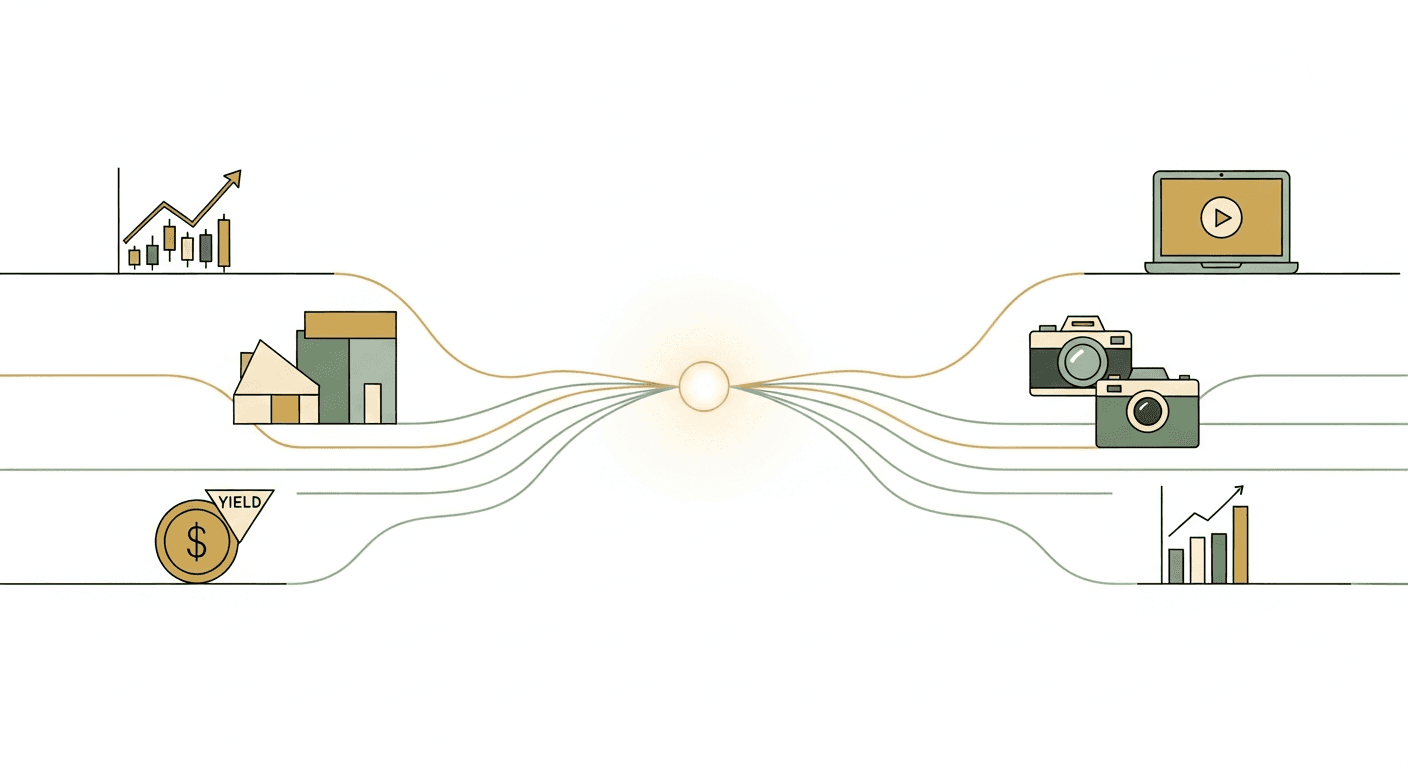
Passive income in 2025 and 2026 spans three broad buckets: investment income (dividends, savings interest, crypto yield), digital assets (courses, content sites, stock media), and physical assets (real estate, vending, EV stations). According to the US Census Bureau, about 20% of American households earn some form of passive income, with a median of $4,200 per year. For investors who want yield on capital without constant hands-on work, a combination of dividend stocks (3-5% APY), high-yield savings accounts (4-5%), and crypto lending or staking (4-12% APY depending on the protocol and risk tier) covers most use cases. The right mix depends on your capital, risk tolerance, and how much setup work you're willing to do upfront.
Key takeaways
Passive income takes upfront work. Every strategy on this list requires either capital, time, or both before it generates returns.
Returns vary by risk: savings accounts pay 4-5%, dividend stocks pay 3-5%, and crypto yield ranges from 3% (ETH staking) to 10-15% (DeFi lending) with proportionally higher risk.
Diversification matters. Combining two or three income streams from different categories reduces concentration risk and smooths out volatile periods.
Tax matters too. Crypto yield, dividends, and rental income are all taxed differently. Run the numbers before choosing a strategy.
1. Dividend stocks
Dividend stocks are the textbook passive income starter. You buy shares in companies that pay out a portion of their profits to shareholders, typically every quarter. You don't have to do anything after the initial investment. The money shows up in your brokerage account.
The S&P 500's average dividend yield is around 1.5% right now, which isn't exciting. But dividend-focused indices and ETFs like VYM (Vanguard High Dividend Yield) or SCHD (Schwab US Dividend Equity) track companies with stronger yields, often 3-4.5%. For context, a $50,000 portfolio in a fund like SCHD historically returns about $1,500-$2,200 per year in dividends alone, plus any price appreciation.
The real compounding happens when you reinvest those dividends. Over a decade, the difference between reinvesting and spending dividends is substantial.
Setup effort: Low. Open a brokerage account, buy an ETF, done.
Ongoing effort: Near zero. Annual rebalancing at most.
Realistic annual return: 3-5% dividend yield, plus market appreciation.
Minimum capital needed: Any amount. Returns scale with investment size.
2. High-yield savings accounts and CDs
This is the safest passive income option and the least exciting. After a period of near-zero interest rates, high-yield savings accounts are now paying 4-5% APY at online banks like Marcus, Ally, and SoFi. That's not bad for money that's fully liquid and FDIC-insured.
Certificates of deposit (CDs) lock up your money for 3 months to 5 years in exchange for a fixed, slightly higher rate. A 12-month CD at a competitive bank currently pays around 4.5-5%.
The catch: you're not really beating inflation over the long term, and rates will eventually come down. These work best as a parking spot for cash you need liquid but want to earn something on in the meantime.
Setup effort: Very low. Open an account online in 15 minutes.
Ongoing effort: None.
Realistic annual return: 4-5% APY, fully guaranteed.
Minimum capital needed: Varies by bank; many require $0-$1,000.
3. Real estate investment trusts (REITs)
If you want real estate income without the landlord headaches, REITs give you that. They're companies that own income-producing real estate (apartments, offices, data centers, cell towers) and are legally required to pay out at least 90% of taxable income as dividends.
The average REIT dividend yield is around 4-5%, but individual REITs vary widely. Data center REITs like Digital Realty and healthcare REITs like Welltower have performed well over the past several years. REIT ETFs like VNQ (Vanguard Real Estate) simplify diversification.
REITs are more volatile than savings accounts and move with the stock market. They're an investment, not a savings product.
Setup effort: Low. Bought like any stock in a brokerage account.
Ongoing effort: Low. Review holdings once or twice per year.
Realistic annual return: 4-6% dividend yield, plus/minus price movement.
Minimum capital needed: Any amount via ETFs.
4. What is crypto staking and DeFi yield?
Crypto offers some of the highest passive income yields available right now, with proportionally higher risk. The range is wide: Ethereum staking pays about 3.5-4.2% APY, while DeFi lending on platforms like Aave or Compound pays 4-7% on stablecoins. Higher-yield DeFi strategies can reach 10-15% but carry meaningful smart contract and liquidity risk.
For crypto holders who already have ETH or stablecoins, putting idle assets to work in yield-generating protocols is a straightforward way to generate passive income. The main variables are: which protocol you choose, what the risk grade is, and whether you're comfortable with non-custodial DeFi.
Gas fees are a real friction point for most DeFi participation. On Ethereum mainnet, a single transaction can cost $20-$50 during busy periods, which eats into returns on small positions. Platforms that batch transactions or operate on L2 networks significantly reduce this.
Pistachio.fi is a crypto yield platform that addresses several of these friction points: curated vaults vetted for protocol safety, expert risk grades on every vault, and zero gas fees. For ETH or stablecoin holders looking for DeFi exposure without manually evaluating every protocol, it's a practical entry point. Users can see current APYs across Aave, Morpho, and other protocols in one interface, with the Awaken.Tax integration handling tax reporting automatically.
For context on risk: DeFiLlama tracks total value locked across DeFi protocols. As of early 2026, the total DeFi TVL remains in the hundreds of billions, suggesting continued institutional and retail participation despite market cycles.
Setup effort: Medium. Requires a crypto wallet and understanding of the protocol.
Ongoing effort: Low to medium. Monitor positions, rebalance occasionally.
Realistic annual return: 3.5-12% APY depending on strategy and risk.
Minimum capital needed: Any amount; returns are more meaningful at $1,000+.
5. Online courses and digital products
If you have expertise in something people want to learn, turning it into a course is one of the few passive income strategies where the upfront cost is mostly time, not money. Once a course is live on Udemy, Teachable, or your own site, it can sell indefinitely without you being present.
The numbers vary dramatically by topic and platform. A well-reviewed Udemy course in a technical category (Python, data analysis, design) can generate $500-$2,000 per month passively after the initial ramp-up. Marketing-heavy categories require more ongoing promotion.
Digital products (templates, planners, Notion dashboards, Photoshop presets) work similarly. The creation effort is front-loaded; distribution platforms like Gumroad, Etsy, or Lemon Squeezy handle the rest.
Setup effort: High. Creating good course content takes weeks or months.
Ongoing effort: Low after launch. Occasional updates and customer questions.
Realistic annual return: Highly variable. $0-$30,000+, depends on topic and audience.
Minimum capital needed: Near zero. A microphone and screen recorder are sufficient.
6. Content websites and blogs
A content website generates passive income through display advertising (Google AdSense, Mediavine, Raptive) and affiliate commissions. The key metric is organic traffic. Once articles rank on Google, they drive traffic and revenue without you writing new posts.
Ad revenue on Mediavine and Raptive pays $20-$50 per 1,000 sessions for niche audiences. A site with 30,000 monthly sessions in a personal finance or health niche can earn $600-$1,500 per month from ads alone, plus affiliate revenue on top.
The honest caveat: reaching that traffic level takes 12-24 months in most niches, and Google algorithm changes can hurt a site's rankings overnight. It's passive once established, but the establishment phase is real work.
Setup effort: Very high. Writing, SEO, and site maintenance for 1-2 years before meaningful income.
Ongoing effort: Medium. New content helps but isn't always required.
Realistic annual return: $0-$50,000+ per year depending on traffic.
Minimum capital needed: $100-$500 for hosting and tools.
7. YouTube and video content
YouTube's ad revenue model pays creators when videos get views, including on old videos. The actual revenue rate is $3-$8 per 1,000 views (RPM varies by niche and region), which means you need meaningful traffic for it to matter.
What makes YouTube genuinely passive is that evergreen videos, tutorials, and explainers keep generating views years after publication. A "how to file your taxes in 2024" video published two years ago still ranks and earns every February.
The threshold for monetization is 1,000 subscribers and 4,000 watch hours, which typically takes 6-18 months to reach. Building to that point involves consistent output.
Setup effort: High. Regular uploads for months before monetization opens.
Ongoing effort: Medium. New content keeps the algorithm happy; old content earns regardless.
Realistic annual return: Variable. $0 during ramp-up, $5,000-$60,000+ at scale.
Minimum capital needed: $200-$1,000 for basic camera and editing gear.
8. Rental property
Long-term rentals generate monthly income once you've screened good tenants. The gross yield on residential rental properties in the US ranges widely, but cap rates in most markets are 4-7% right now. After expenses (maintenance, property management, insurance, mortgage interest), net returns are lower.
The "passive" part only works if you hire a property management company (typically 8-12% of monthly rent). Without property management, being a landlord involves real ongoing work. With it, rental income is fairly hands-off once the property is occupied.
Real estate requires substantial capital. A 20% down payment on a $300,000 rental property is $60,000, plus closing costs and a reserve fund for repairs.
Setup effort: Very high. Finding, buying, and getting a rental property occupied takes months.
Ongoing effort: Low with a property manager, medium without one.
Realistic annual return: 3-6% net cap rate after expenses in most markets.
Minimum capital needed: $50,000-$100,000+ depending on market.
9. Peer-to-peer lending
P2P lending platforms connect investors with borrowers, letting you earn interest income on personal or business loans. In the US, platforms like Prosper and Fundrise (for real estate debt) offer returns in the 5-8% range, though with real default risk on individual loans.
The key is diversification: spreading investments across 50-100 loans means a few defaults don't wipe out your returns. P2P lending is less liquid than stocks or savings accounts. Getting your money back before loans mature typically involves selling notes on a secondary market at a discount.
Setup effort: Low to medium. Account setup and initial allocation take a few hours.
Ongoing effort: Low. Reinvesting principal and interest payments occasionally.
Realistic annual return: 5-8% in normal conditions, lower during credit stress.
Minimum capital needed: $1,000-$5,000 for meaningful diversification.
10. Stock photography and media licensing
Photographers, videographers, and illustrators can upload work to Shutterstock, Getty Images, Adobe Stock, and iStock to earn royalties every time a commercial user licenses their content. Returns per download are low ($0.25-$2 per image on most platforms), but a portfolio of 1,000-5,000 images can generate a few hundred dollars per month with no ongoing effort.
The upfront investment is a good camera and the time to build a portfolio. Niche content (business situations, diverse people, specific industries) tends to license better than generic landscapes and portraits.
Setup effort: Medium. Building a sellable portfolio requires significant shooting time.
Ongoing effort: Low. Upload new work occasionally; existing work earns passively.
Realistic annual return: $500-$5,000+ per year with a mature portfolio.
Minimum capital needed: $500-$2,000 for camera gear (or use a modern smartphone).
How do you pick the right passive income strategy?
Most people don't choose one strategy; they combine two or three. The question is which combination fits your situation. A few things worth sorting out before you start:
Capital vs. time. Dividend stocks, REITs, savings accounts, and crypto yield all require capital but minimal time. Courses, YouTube, and content sites require time upfront but minimal capital. Rental property requires both.
Risk tolerance. Savings accounts have essentially zero principal risk. Dividend stocks and REITs can lose value. Crypto yield involves smart contract risk on top of price volatility. DeFi positions can be liquidated if collateral values move against you. Higher returns generally come with higher risk.
Time horizon. Content sites and YouTube take 1-2 years to generate meaningful income. Dividend stocks and high-yield savings accounts start earning on day one. Crypto staking starts earning within a day or two of depositing.
Tax situation. Dividends, rental income, and crypto yield are all taxed differently. Interest income (savings, P2P) is taxed as ordinary income. Qualified dividends get preferential rates. Crypto yield is typically taxed as ordinary income when earned, plus capital gains on any appreciation when sold. A session with a CPA before you deploy significant capital is money well spent.
Strategy | Typical APY / Return | Capital needed | Setup effort | Liquidity |
|---|---|---|---|---|
Dividend stocks (ETF) | 3-5% | Any | Very low | High |
High-yield savings | 4-5% | Any | Very low | Very high |
REITs | 4-6% | Any | Low | High |
Crypto staking / DeFi yield | 3.5-12% | $500+ | Medium | Medium-High |
Online courses | Variable | Near zero | Very high | Immediate cash |
Content website | Variable | $100-$500 | Very high | Slow to build |
Rental property | 3-6% net | $50,000+ | Very high | Very low |
P2P lending | 5-8% | $1,000+ | Low | Low-Medium |
Stock photography | Variable | $500+ | Medium | Immediate cash |
If you hold crypto and want to put it to work earning yield, Pistachio.fi lets you access curated DeFi vaults with zero gas fees and expert risk grades on every position. See current APYs across Aave, Morpho, and other vetted protocols. The security model is designed for long-term holders who want yield without giving up self-custody.
For further reading on yield strategies, see the Pistachio.fi guides on Ethereum staking yield and stablecoin yield in a bear market. External data on DeFi yields is tracked in real time on DeFiLlama, and stablecoin rates are available on CoinMarketCap's yield page.
Frequently asked questions
What is the best passive income idea in 2025 and 2026?
There's no single best option because it depends on your capital and time. For investors with capital, dividend ETFs and high-yield savings accounts are the lowest-effort starting point. Crypto yield (staking or DeFi) offers higher returns for those comfortable with the technology. For people with expertise, online courses are the best option when capital is limited.
How much money do you need to make $1,000 per month in passive income?
At 5% APY (a realistic return from a high-yield savings account or dividend ETF), you'd need about $240,000 in invested capital. At 10% APY (achievable in DeFi but with more risk), you'd need $120,000. Lower-capital options like courses or content sites can reach $1,000/month with less initial capital but more upfront time.
Is crypto a good passive income strategy?
It can be, if you already hold crypto. ETH staking currently pays about 3.5-4.2% APY, which is comparable to a high-yield savings account. DeFi lending on stablecoins typically pays 4-7%. Risks include smart contract vulnerabilities, protocol failures, and underlying asset price volatility. Managing those risks is the key challenge in DeFi yield strategies.
How is passive income taxed in the US?
It depends on the source. Savings account interest and P2P lending income are taxed as ordinary income. Qualified dividends are taxed at preferential long-term capital gains rates. Rental income is taxed as ordinary income with deductions for depreciation and expenses. Crypto yield is generally taxed as ordinary income when received. The IRS treats these differently, so consult a tax professional before committing significant capital to any strategy.
What passive income ideas work with no money upfront?
No-capital strategies require time instead. Online courses, YouTube, content websites, and stock photography all require meaningful time investment before generating income. The tradeoff: the return potential is open-ended, not capped by how much you can deposit.
Last updated: March 2026
Most passive income advice promises a lot and delivers little. The pitch goes: set it up once, walk away, collect money. The reality is messier. Some strategies take months before they pay a dollar. Others require real capital upfront. A few genuinely work at scale once they get going.
This guide covers 10 passive income strategies worth your attention in 2025 and 2026, from dividend stocks to DeFi yield. Each one includes realistic numbers, the actual effort involved, and a clear-eyed view of the risks.
Passive income in 2025 and 2026 spans three broad buckets: investment income (dividends, savings interest, crypto yield), digital assets (courses, content sites, stock media), and physical assets (real estate, vending, EV stations). According to the US Census Bureau, about 20% of American households earn some form of passive income, with a median of $4,200 per year. For investors who want yield on capital without constant hands-on work, a combination of dividend stocks (3-5% APY), high-yield savings accounts (4-5%), and crypto lending or staking (4-12% APY depending on the protocol and risk tier) covers most use cases. The right mix depends on your capital, risk tolerance, and how much setup work you're willing to do upfront.
Key takeaways
Passive income takes upfront work. Every strategy on this list requires either capital, time, or both before it generates returns.
Returns vary by risk: savings accounts pay 4-5%, dividend stocks pay 3-5%, and crypto yield ranges from 3% (ETH staking) to 10-15% (DeFi lending) with proportionally higher risk.
Diversification matters. Combining two or three income streams from different categories reduces concentration risk and smooths out volatile periods.
Tax matters too. Crypto yield, dividends, and rental income are all taxed differently. Run the numbers before choosing a strategy.
1. Dividend stocks
Dividend stocks are the textbook passive income starter. You buy shares in companies that pay out a portion of their profits to shareholders, typically every quarter. You don't have to do anything after the initial investment. The money shows up in your brokerage account.
The S&P 500's average dividend yield is around 1.5% right now, which isn't exciting. But dividend-focused indices and ETFs like VYM (Vanguard High Dividend Yield) or SCHD (Schwab US Dividend Equity) track companies with stronger yields, often 3-4.5%. For context, a $50,000 portfolio in a fund like SCHD historically returns about $1,500-$2,200 per year in dividends alone, plus any price appreciation.
The real compounding happens when you reinvest those dividends. Over a decade, the difference between reinvesting and spending dividends is substantial.
Setup effort: Low. Open a brokerage account, buy an ETF, done.
Ongoing effort: Near zero. Annual rebalancing at most.
Realistic annual return: 3-5% dividend yield, plus market appreciation.
Minimum capital needed: Any amount. Returns scale with investment size.
2. High-yield savings accounts and CDs
This is the safest passive income option and the least exciting. After a period of near-zero interest rates, high-yield savings accounts are now paying 4-5% APY at online banks like Marcus, Ally, and SoFi. That's not bad for money that's fully liquid and FDIC-insured.
Certificates of deposit (CDs) lock up your money for 3 months to 5 years in exchange for a fixed, slightly higher rate. A 12-month CD at a competitive bank currently pays around 4.5-5%.
The catch: you're not really beating inflation over the long term, and rates will eventually come down. These work best as a parking spot for cash you need liquid but want to earn something on in the meantime.
Setup effort: Very low. Open an account online in 15 minutes.
Ongoing effort: None.
Realistic annual return: 4-5% APY, fully guaranteed.
Minimum capital needed: Varies by bank; many require $0-$1,000.
3. Real estate investment trusts (REITs)
If you want real estate income without the landlord headaches, REITs give you that. They're companies that own income-producing real estate (apartments, offices, data centers, cell towers) and are legally required to pay out at least 90% of taxable income as dividends.
The average REIT dividend yield is around 4-5%, but individual REITs vary widely. Data center REITs like Digital Realty and healthcare REITs like Welltower have performed well over the past several years. REIT ETFs like VNQ (Vanguard Real Estate) simplify diversification.
REITs are more volatile than savings accounts and move with the stock market. They're an investment, not a savings product.
Setup effort: Low. Bought like any stock in a brokerage account.
Ongoing effort: Low. Review holdings once or twice per year.
Realistic annual return: 4-6% dividend yield, plus/minus price movement.
Minimum capital needed: Any amount via ETFs.
4. What is crypto staking and DeFi yield?
Crypto offers some of the highest passive income yields available right now, with proportionally higher risk. The range is wide: Ethereum staking pays about 3.5-4.2% APY, while DeFi lending on platforms like Aave or Compound pays 4-7% on stablecoins. Higher-yield DeFi strategies can reach 10-15% but carry meaningful smart contract and liquidity risk.
For crypto holders who already have ETH or stablecoins, putting idle assets to work in yield-generating protocols is a straightforward way to generate passive income. The main variables are: which protocol you choose, what the risk grade is, and whether you're comfortable with non-custodial DeFi.
Gas fees are a real friction point for most DeFi participation. On Ethereum mainnet, a single transaction can cost $20-$50 during busy periods, which eats into returns on small positions. Platforms that batch transactions or operate on L2 networks significantly reduce this.
Pistachio.fi is a crypto yield platform that addresses several of these friction points: curated vaults vetted for protocol safety, expert risk grades on every vault, and zero gas fees. For ETH or stablecoin holders looking for DeFi exposure without manually evaluating every protocol, it's a practical entry point. Users can see current APYs across Aave, Morpho, and other protocols in one interface, with the Awaken.Tax integration handling tax reporting automatically.
For context on risk: DeFiLlama tracks total value locked across DeFi protocols. As of early 2026, the total DeFi TVL remains in the hundreds of billions, suggesting continued institutional and retail participation despite market cycles.
Setup effort: Medium. Requires a crypto wallet and understanding of the protocol.
Ongoing effort: Low to medium. Monitor positions, rebalance occasionally.
Realistic annual return: 3.5-12% APY depending on strategy and risk.
Minimum capital needed: Any amount; returns are more meaningful at $1,000+.
5. Online courses and digital products
If you have expertise in something people want to learn, turning it into a course is one of the few passive income strategies where the upfront cost is mostly time, not money. Once a course is live on Udemy, Teachable, or your own site, it can sell indefinitely without you being present.
The numbers vary dramatically by topic and platform. A well-reviewed Udemy course in a technical category (Python, data analysis, design) can generate $500-$2,000 per month passively after the initial ramp-up. Marketing-heavy categories require more ongoing promotion.
Digital products (templates, planners, Notion dashboards, Photoshop presets) work similarly. The creation effort is front-loaded; distribution platforms like Gumroad, Etsy, or Lemon Squeezy handle the rest.
Setup effort: High. Creating good course content takes weeks or months.
Ongoing effort: Low after launch. Occasional updates and customer questions.
Realistic annual return: Highly variable. $0-$30,000+, depends on topic and audience.
Minimum capital needed: Near zero. A microphone and screen recorder are sufficient.
6. Content websites and blogs
A content website generates passive income through display advertising (Google AdSense, Mediavine, Raptive) and affiliate commissions. The key metric is organic traffic. Once articles rank on Google, they drive traffic and revenue without you writing new posts.
Ad revenue on Mediavine and Raptive pays $20-$50 per 1,000 sessions for niche audiences. A site with 30,000 monthly sessions in a personal finance or health niche can earn $600-$1,500 per month from ads alone, plus affiliate revenue on top.
The honest caveat: reaching that traffic level takes 12-24 months in most niches, and Google algorithm changes can hurt a site's rankings overnight. It's passive once established, but the establishment phase is real work.
Setup effort: Very high. Writing, SEO, and site maintenance for 1-2 years before meaningful income.
Ongoing effort: Medium. New content helps but isn't always required.
Realistic annual return: $0-$50,000+ per year depending on traffic.
Minimum capital needed: $100-$500 for hosting and tools.
7. YouTube and video content
YouTube's ad revenue model pays creators when videos get views, including on old videos. The actual revenue rate is $3-$8 per 1,000 views (RPM varies by niche and region), which means you need meaningful traffic for it to matter.
What makes YouTube genuinely passive is that evergreen videos, tutorials, and explainers keep generating views years after publication. A "how to file your taxes in 2024" video published two years ago still ranks and earns every February.
The threshold for monetization is 1,000 subscribers and 4,000 watch hours, which typically takes 6-18 months to reach. Building to that point involves consistent output.
Setup effort: High. Regular uploads for months before monetization opens.
Ongoing effort: Medium. New content keeps the algorithm happy; old content earns regardless.
Realistic annual return: Variable. $0 during ramp-up, $5,000-$60,000+ at scale.
Minimum capital needed: $200-$1,000 for basic camera and editing gear.
8. Rental property
Long-term rentals generate monthly income once you've screened good tenants. The gross yield on residential rental properties in the US ranges widely, but cap rates in most markets are 4-7% right now. After expenses (maintenance, property management, insurance, mortgage interest), net returns are lower.
The "passive" part only works if you hire a property management company (typically 8-12% of monthly rent). Without property management, being a landlord involves real ongoing work. With it, rental income is fairly hands-off once the property is occupied.
Real estate requires substantial capital. A 20% down payment on a $300,000 rental property is $60,000, plus closing costs and a reserve fund for repairs.
Setup effort: Very high. Finding, buying, and getting a rental property occupied takes months.
Ongoing effort: Low with a property manager, medium without one.
Realistic annual return: 3-6% net cap rate after expenses in most markets.
Minimum capital needed: $50,000-$100,000+ depending on market.
9. Peer-to-peer lending
P2P lending platforms connect investors with borrowers, letting you earn interest income on personal or business loans. In the US, platforms like Prosper and Fundrise (for real estate debt) offer returns in the 5-8% range, though with real default risk on individual loans.
The key is diversification: spreading investments across 50-100 loans means a few defaults don't wipe out your returns. P2P lending is less liquid than stocks or savings accounts. Getting your money back before loans mature typically involves selling notes on a secondary market at a discount.
Setup effort: Low to medium. Account setup and initial allocation take a few hours.
Ongoing effort: Low. Reinvesting principal and interest payments occasionally.
Realistic annual return: 5-8% in normal conditions, lower during credit stress.
Minimum capital needed: $1,000-$5,000 for meaningful diversification.
10. Stock photography and media licensing
Photographers, videographers, and illustrators can upload work to Shutterstock, Getty Images, Adobe Stock, and iStock to earn royalties every time a commercial user licenses their content. Returns per download are low ($0.25-$2 per image on most platforms), but a portfolio of 1,000-5,000 images can generate a few hundred dollars per month with no ongoing effort.
The upfront investment is a good camera and the time to build a portfolio. Niche content (business situations, diverse people, specific industries) tends to license better than generic landscapes and portraits.
Setup effort: Medium. Building a sellable portfolio requires significant shooting time.
Ongoing effort: Low. Upload new work occasionally; existing work earns passively.
Realistic annual return: $500-$5,000+ per year with a mature portfolio.
Minimum capital needed: $500-$2,000 for camera gear (or use a modern smartphone).
How do you pick the right passive income strategy?
Most people don't choose one strategy; they combine two or three. The question is which combination fits your situation. A few things worth sorting out before you start:
Capital vs. time. Dividend stocks, REITs, savings accounts, and crypto yield all require capital but minimal time. Courses, YouTube, and content sites require time upfront but minimal capital. Rental property requires both.
Risk tolerance. Savings accounts have essentially zero principal risk. Dividend stocks and REITs can lose value. Crypto yield involves smart contract risk on top of price volatility. DeFi positions can be liquidated if collateral values move against you. Higher returns generally come with higher risk.
Time horizon. Content sites and YouTube take 1-2 years to generate meaningful income. Dividend stocks and high-yield savings accounts start earning on day one. Crypto staking starts earning within a day or two of depositing.
Tax situation. Dividends, rental income, and crypto yield are all taxed differently. Interest income (savings, P2P) is taxed as ordinary income. Qualified dividends get preferential rates. Crypto yield is typically taxed as ordinary income when earned, plus capital gains on any appreciation when sold. A session with a CPA before you deploy significant capital is money well spent.
Strategy | Typical APY / Return | Capital needed | Setup effort | Liquidity |
|---|---|---|---|---|
Dividend stocks (ETF) | 3-5% | Any | Very low | High |
High-yield savings | 4-5% | Any | Very low | Very high |
REITs | 4-6% | Any | Low | High |
Crypto staking / DeFi yield | 3.5-12% | $500+ | Medium | Medium-High |
Online courses | Variable | Near zero | Very high | Immediate cash |
Content website | Variable | $100-$500 | Very high | Slow to build |
Rental property | 3-6% net | $50,000+ | Very high | Very low |
P2P lending | 5-8% | $1,000+ | Low | Low-Medium |
Stock photography | Variable | $500+ | Medium | Immediate cash |
If you hold crypto and want to put it to work earning yield, Pistachio.fi lets you access curated DeFi vaults with zero gas fees and expert risk grades on every position. See current APYs across Aave, Morpho, and other vetted protocols. The security model is designed for long-term holders who want yield without giving up self-custody.
For further reading on yield strategies, see the Pistachio.fi guides on Ethereum staking yield and stablecoin yield in a bear market. External data on DeFi yields is tracked in real time on DeFiLlama, and stablecoin rates are available on CoinMarketCap's yield page.
Frequently asked questions
What is the best passive income idea in 2025 and 2026?
There's no single best option because it depends on your capital and time. For investors with capital, dividend ETFs and high-yield savings accounts are the lowest-effort starting point. Crypto yield (staking or DeFi) offers higher returns for those comfortable with the technology. For people with expertise, online courses are the best option when capital is limited.
How much money do you need to make $1,000 per month in passive income?
At 5% APY (a realistic return from a high-yield savings account or dividend ETF), you'd need about $240,000 in invested capital. At 10% APY (achievable in DeFi but with more risk), you'd need $120,000. Lower-capital options like courses or content sites can reach $1,000/month with less initial capital but more upfront time.
Is crypto a good passive income strategy?
It can be, if you already hold crypto. ETH staking currently pays about 3.5-4.2% APY, which is comparable to a high-yield savings account. DeFi lending on stablecoins typically pays 4-7%. Risks include smart contract vulnerabilities, protocol failures, and underlying asset price volatility. Managing those risks is the key challenge in DeFi yield strategies.
How is passive income taxed in the US?
It depends on the source. Savings account interest and P2P lending income are taxed as ordinary income. Qualified dividends are taxed at preferential long-term capital gains rates. Rental income is taxed as ordinary income with deductions for depreciation and expenses. Crypto yield is generally taxed as ordinary income when received. The IRS treats these differently, so consult a tax professional before committing significant capital to any strategy.
What passive income ideas work with no money upfront?
No-capital strategies require time instead. Online courses, YouTube, content websites, and stock photography all require meaningful time investment before generating income. The tradeoff: the return potential is open-ended, not capped by how much you can deposit.

Cross-chain crypto swaps: how Li.Fi powers Pistachio's one-tap zaps (2026)

Etherfuse stablebonds: earn government bond yields on-chain (2026)
How to earn money online in 2026 (crypto yield vs. the rest)
Linea crypto explained: what it is and how it works (2026)

Ethereum wallet guide 2026 (ethernet wallet explained)

DeFi Staking with Stader Labs: How ETHx Works in 2026

High-liquidity crypto exchanges: PancakeSwap guide 2026

What is Raydium? How Solana's AMM Works in 2026
Passive Income Ideas for 2026: 10 Ways That Actually Work

Hong Kong crypto news 2026: licenses, stablecoins, and regulation
©2026 Copyright, PistachioFi Inc.
©2026 Copyright, PistachioFi Inc.
©2026 Copyright, PistachioFi Inc.