Ethereum and the Agentic Economy: Why AI Agents Need Blockchain
Ethereum and the Agentic Economy: Why AI Agents Need Blockchain

Ethereum and the Agentic Economy: Why AI Agents Need Blockchain
Ethereum and the Agentic Economy: Why AI Agents Need Blockchain
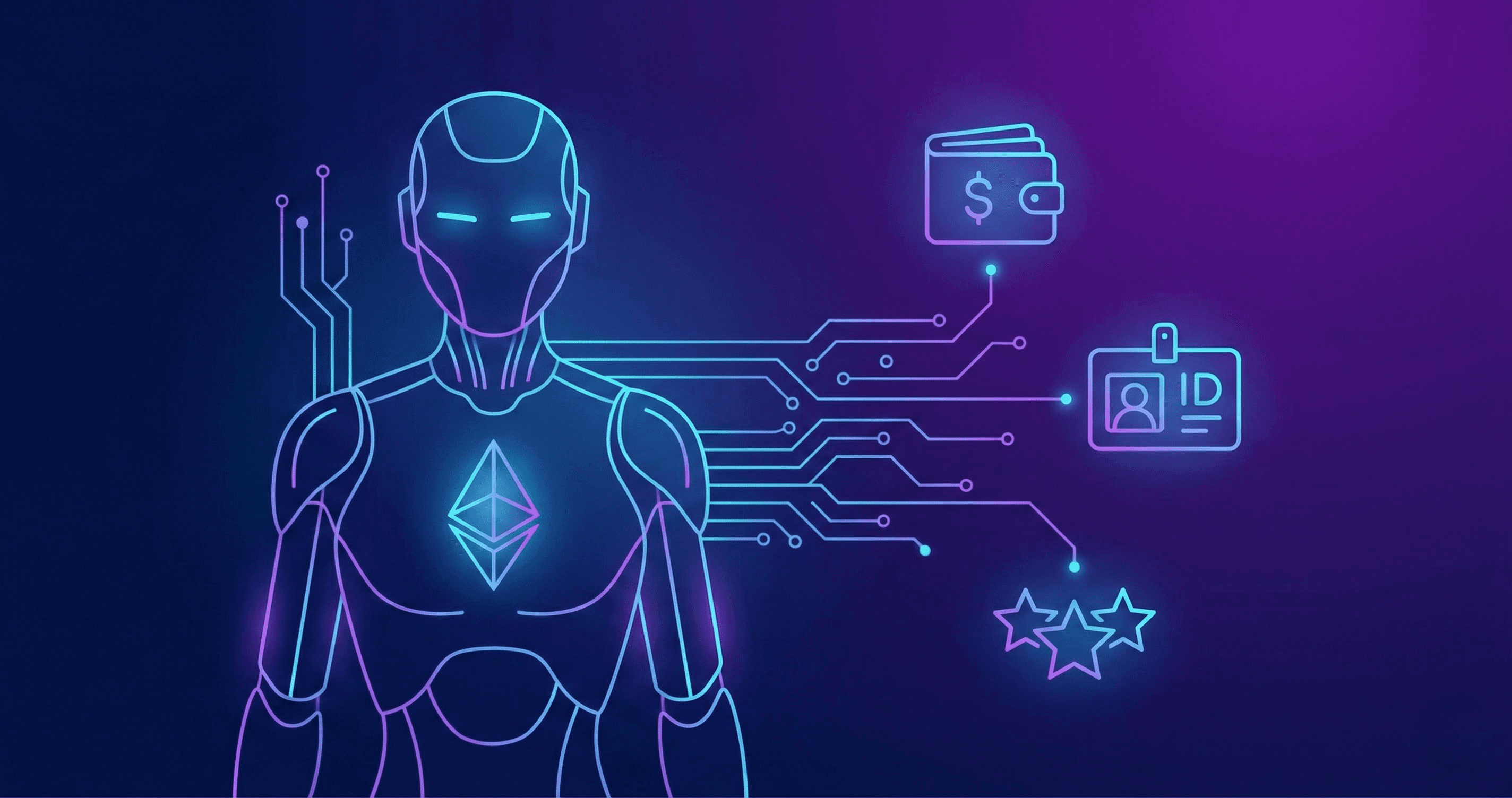
In financial services, non-human identities now outnumber human employees 96-to-1. These aren't simple scripts running background tasks. They're AI agents that hold wallets, execute trades, pay for services, and generate revenue without human intervention.
Welcome to the agentic economy. Ethereum just shipped the infrastructure to make it work.
Key takeaways
2026 is the "Year of the Agent" according to a16z crypto, with AI agents becoming genuine economic actors.
ERC-8004 gives AI agents on-chain identity, reputation, and validation. Co-authored by MetaMask, Google, and Coinbase.
Agents need blockchain for persistent identity, programmable payments, and censorship-resistant infrastructure.
Smart accounts (ERC-4337) already support agent delegation, making platforms like Pistachio agent-ready today.
What is the agentic economy?
The agentic economy is what happens when AI systems stop being tools and start being participants. Instead of humans using AI to complete tasks, AI agents operate autonomously as economic actors.
These agents hold cryptocurrency wallets. They buy compute time from GPU providers. They pay for API calls. They execute trades based on market conditions. They earn revenue by providing services to other agents or humans. All without asking permission for each transaction.
This isn't theoretical. It's happening now. Gartner projects the agentic economy will reach $30 trillion by 2030. Ethereum is positioning itself as the settlement layer where these agents will transact.
Why do AI agents need blockchain?
You might wonder why AI agents can't just use traditional payment rails. Why can't an AI use Stripe or PayPal like any other software?
The answer comes down to four things that traditional systems can't provide.
Persistent identity
An AI agent needs an identity that persists across platforms, survives organizational changes, and can't be arbitrarily revoked. Traditional accounts are controlled by companies. If OpenAI or Google decides to shut down an agent's account, that identity disappears.
Blockchain provides cryptographic identity that the agent (or its owner) controls. No platform can take it away. This matters for agents that need to build reputation over time.
Programmable payments
AI agents need to transact at machine speed. Waiting for human approval on every payment defeats the purpose of autonomy. Traditional payment systems require human authorization, have business hours, and impose arbitrary limits.
Smart contracts enable programmatic payments with built-in rules. An agent can be authorized to spend up to a certain amount per day, or only on specific types of services, or only when certain conditions are met. The rules are enforced by code, not by hoping the agent follows instructions.
Reputation and trust
When an AI agent interacts with another AI agent, how do they know they can trust each other? There's no LinkedIn profile. No Yelp reviews. No business license to verify.
On-chain reputation registries solve this. Every agent's transaction history is public and verifiable. Did this agent complete its last 1,000 jobs successfully? Did it pay on time? Did other agents rate it positively? This information lives on-chain where it can't be faked or deleted.
Censorship resistance
An AI agent serving users in one country might need to interact with services in another. Traditional financial systems are fragmented by jurisdiction, with each imposing its own restrictions.
Blockchain operates globally, 24/7, without requiring permission from any government or corporation. An agent in Singapore can pay an agent in Brazil in seconds, settling on a neutral network neither party controls.
What is ERC-8004?
ERC-8004 is Ethereum's new standard for "Trustless Agents." It provides infrastructure for AI agents to discover each other, establish trust, and transact across organizational boundaries.
The standard was co-authored by Marco De Rossi from MetaMask, Davide Crapis from the Ethereum Foundation, Jordan Ellis from Google, and Erik Reppel from Coinbase. When engineers from the largest names in crypto infrastructure collaborate on a standard, pay attention.
ERC-8004 introduces three registries that work together.
Identity registry
Every agent gets a portable, censorship-resistant identifier based on ERC-721 (the NFT standard). The owner of the token owns the agent and can transfer ownership or delegate management to operators.
The identity resolves to a registration file containing the agent's capabilities, contact information, and operating parameters. Think of it as a machine-readable business card that lives permanently on Ethereum.
Reputation registry
A standard interface for posting and fetching feedback about agents. Other agents can rate interactions, report problems, and contribute to aggregate reputation scores.
Scoring happens both on-chain (for composability with other smart contracts) and off-chain (for more sophisticated algorithms). This opens up specialized services for agent scoring, auditor networks, and insurance pools.
Validation registry
Generic hooks for independent verification. If an agent claims to have completed a task, validators can confirm it. These might be stakers who re-run the job, zero-knowledge proof verifiers, trusted execution environment oracles, or human judges for subjective quality assessment.
Together, these registries give agents what they need to find each other, establish trust, and verify work.
How will AI agents use DeFi?
Once AI agents have identity, reputation, and payment infrastructure, they can participate in decentralized finance.
Automated yield optimization
AI agents can monitor yield opportunities across hundreds of protocols simultaneously. When rates shift, they can rebalance positions instantly. No sleeping, no weekends, no emotional attachment to losing positions.
These agents don't just follow simple rules. They can evaluate smart contract risk, assess liquidity depth, and factor in gas costs before making decisions. They optimize across dimensions humans can't track manually.
24/7 arbitrage
Price discrepancies between exchanges last milliseconds. Human traders can't capture them. AI agents operating on-chain can identify and execute arbitrage opportunities faster than any human, providing market efficiency while generating profits.
Autonomous liquidity provision
Concentrated liquidity pools require constant management to stay in range. AI agents can monitor price movements and adjust positions automatically, capturing fees while minimizing impermanent loss.
Multi-agent coordination
The interesting possibilities emerge when agents collaborate. One agent might specialize in risk assessment, another in execution, another in market analysis. They can form temporary coalitions, split profits according to smart contract rules, and dissolve when the opportunity passes.
How is Pistachio agent-ready?
If you're using Pistachio today, you're already on infrastructure designed for the agentic economy.
Pistachio is built on smart accounts (ERC-4337), which support delegation natively. An AI agent could be authorized to manage a vault position on your behalf, with programmatic limits you define. The agent can rebalance, claim rewards, or adjust exposure without needing your signature for every transaction.
The gasless infrastructure works well for autonomous agents. When an agent needs to execute a transaction, it shouldn't have to worry about holding ETH for gas. Pistachio handles gas abstraction, letting agents focus on strategy rather than transaction mechanics.
The curated vault structure provides guardrails that matter for agent safety. Rather than letting an agent interact with any protocol on the internet, Pistachio vaults constrain the strategy to vetted, audited protocols. This limits the attack surface for agents operating with delegated authority.
As the agentic economy matures, expect to see more explicit agent integration: automated vault management, agent-optimized yield strategies, multi-agent coordination for complex DeFi positions. The foundation is already in place.
What does Know Your Agent (KYA) mean?
One emerging concept in the agentic economy is Know Your Agent, or KYA. It's the AI equivalent of Know Your Customer regulations in traditional finance.
KYA creates a cryptographic identity system linking AI agents to their human principals, operational constraints, and legal liabilities. If an agent misbehaves, you can trace back to the responsible party.
This matters for regulatory compliance. As agents manage larger sums and make more consequential decisions, regulators will demand accountability. KYA provides that without sacrificing the efficiency gains of autonomous operation.
What's coming next?
ERC-8004 is in peer review with a stable v2 specification coming soon. The proposed updates include MCP support for broader compatibility, NFT-based agent ownership improvements, more flexible on-chain data storage for reputation, and cleaner integration with the x402 payment protocol.
Ethereum's Glamsterdam hard fork, expected in Q1/Q2 2026, will include infrastructure improvements that make agent operation more practical. Faster block times mean faster settlement. Lower fees mean more economically viable microtransactions.
More than 70 projects are already building on ERC-8004. The race is on to define what agent-native applications look like.
What it comes down to
The agentic economy is a real shift in how value moves through the internet. AI agents are becoming economic actors, and they need infrastructure designed for their requirements.
Ethereum is building that infrastructure with ERC-8004. Persistent identity through NFT-based registries. Reputation systems that can't be gamed. Validation mechanisms for trustless verification.
Pistachio is built on the same smart account infrastructure that enables agent delegation. Whether you're managing your own DeFi portfolio or eventually delegating to an AI agent, the foundation supports both.
2026 is the year agents go from novelty to necessity. The protocols building for this future will capture the next wave of crypto adoption.
Last updated: February 2026
Frequently asked questions
What is ERC-8004?
ERC-8004 is an Ethereum standard for "Trustless Agents" that provides AI agents with on-chain identity, reputation, and validation. It was co-authored by engineers from MetaMask, the Ethereum Foundation, Google, and Coinbase.
Can AI agents hold cryptocurrency?
Yes. AI agents can control cryptocurrency wallets and execute transactions autonomously. With smart accounts (ERC-4337), they can be delegated specific permissions with programmatic limits on what they can spend or do.
What is the agentic economy?
The agentic economy refers to AI agents operating as autonomous economic actors. Instead of humans using AI as tools, agents hold wallets, pay for services, execute trades, and generate revenue independently. Gartner projects it will reach $30 trillion by 2030.
How does ERC-8004 differ from ERC-4337?
ERC-4337 (account abstraction) defines how smart accounts work technically. ERC-8004 builds on top of this to provide identity, reputation, and validation specifically for AI agents operating across organizational boundaries.
Is Pistachio compatible with AI agents?
Pistachio is built on ERC-4337 smart accounts, which support agent delegation natively. The gasless infrastructure and curated vault structure make it suited for autonomous agent operation with appropriate guardrails.
In financial services, non-human identities now outnumber human employees 96-to-1. These aren't simple scripts running background tasks. They're AI agents that hold wallets, execute trades, pay for services, and generate revenue without human intervention.
Welcome to the agentic economy. Ethereum just shipped the infrastructure to make it work.
Key takeaways
2026 is the "Year of the Agent" according to a16z crypto, with AI agents becoming genuine economic actors.
ERC-8004 gives AI agents on-chain identity, reputation, and validation. Co-authored by MetaMask, Google, and Coinbase.
Agents need blockchain for persistent identity, programmable payments, and censorship-resistant infrastructure.
Smart accounts (ERC-4337) already support agent delegation, making platforms like Pistachio agent-ready today.
What is the agentic economy?
The agentic economy is what happens when AI systems stop being tools and start being participants. Instead of humans using AI to complete tasks, AI agents operate autonomously as economic actors.
These agents hold cryptocurrency wallets. They buy compute time from GPU providers. They pay for API calls. They execute trades based on market conditions. They earn revenue by providing services to other agents or humans. All without asking permission for each transaction.
This isn't theoretical. It's happening now. Gartner projects the agentic economy will reach $30 trillion by 2030. Ethereum is positioning itself as the settlement layer where these agents will transact.
Why do AI agents need blockchain?
You might wonder why AI agents can't just use traditional payment rails. Why can't an AI use Stripe or PayPal like any other software?
The answer comes down to four things that traditional systems can't provide.
Persistent identity
An AI agent needs an identity that persists across platforms, survives organizational changes, and can't be arbitrarily revoked. Traditional accounts are controlled by companies. If OpenAI or Google decides to shut down an agent's account, that identity disappears.
Blockchain provides cryptographic identity that the agent (or its owner) controls. No platform can take it away. This matters for agents that need to build reputation over time.
Programmable payments
AI agents need to transact at machine speed. Waiting for human approval on every payment defeats the purpose of autonomy. Traditional payment systems require human authorization, have business hours, and impose arbitrary limits.
Smart contracts enable programmatic payments with built-in rules. An agent can be authorized to spend up to a certain amount per day, or only on specific types of services, or only when certain conditions are met. The rules are enforced by code, not by hoping the agent follows instructions.
Reputation and trust
When an AI agent interacts with another AI agent, how do they know they can trust each other? There's no LinkedIn profile. No Yelp reviews. No business license to verify.
On-chain reputation registries solve this. Every agent's transaction history is public and verifiable. Did this agent complete its last 1,000 jobs successfully? Did it pay on time? Did other agents rate it positively? This information lives on-chain where it can't be faked or deleted.
Censorship resistance
An AI agent serving users in one country might need to interact with services in another. Traditional financial systems are fragmented by jurisdiction, with each imposing its own restrictions.
Blockchain operates globally, 24/7, without requiring permission from any government or corporation. An agent in Singapore can pay an agent in Brazil in seconds, settling on a neutral network neither party controls.
What is ERC-8004?
ERC-8004 is Ethereum's new standard for "Trustless Agents." It provides infrastructure for AI agents to discover each other, establish trust, and transact across organizational boundaries.
The standard was co-authored by Marco De Rossi from MetaMask, Davide Crapis from the Ethereum Foundation, Jordan Ellis from Google, and Erik Reppel from Coinbase. When engineers from the largest names in crypto infrastructure collaborate on a standard, pay attention.
ERC-8004 introduces three registries that work together.
Identity registry
Every agent gets a portable, censorship-resistant identifier based on ERC-721 (the NFT standard). The owner of the token owns the agent and can transfer ownership or delegate management to operators.
The identity resolves to a registration file containing the agent's capabilities, contact information, and operating parameters. Think of it as a machine-readable business card that lives permanently on Ethereum.
Reputation registry
A standard interface for posting and fetching feedback about agents. Other agents can rate interactions, report problems, and contribute to aggregate reputation scores.
Scoring happens both on-chain (for composability with other smart contracts) and off-chain (for more sophisticated algorithms). This opens up specialized services for agent scoring, auditor networks, and insurance pools.
Validation registry
Generic hooks for independent verification. If an agent claims to have completed a task, validators can confirm it. These might be stakers who re-run the job, zero-knowledge proof verifiers, trusted execution environment oracles, or human judges for subjective quality assessment.
Together, these registries give agents what they need to find each other, establish trust, and verify work.
How will AI agents use DeFi?
Once AI agents have identity, reputation, and payment infrastructure, they can participate in decentralized finance.
Automated yield optimization
AI agents can monitor yield opportunities across hundreds of protocols simultaneously. When rates shift, they can rebalance positions instantly. No sleeping, no weekends, no emotional attachment to losing positions.
These agents don't just follow simple rules. They can evaluate smart contract risk, assess liquidity depth, and factor in gas costs before making decisions. They optimize across dimensions humans can't track manually.
24/7 arbitrage
Price discrepancies between exchanges last milliseconds. Human traders can't capture them. AI agents operating on-chain can identify and execute arbitrage opportunities faster than any human, providing market efficiency while generating profits.
Autonomous liquidity provision
Concentrated liquidity pools require constant management to stay in range. AI agents can monitor price movements and adjust positions automatically, capturing fees while minimizing impermanent loss.
Multi-agent coordination
The interesting possibilities emerge when agents collaborate. One agent might specialize in risk assessment, another in execution, another in market analysis. They can form temporary coalitions, split profits according to smart contract rules, and dissolve when the opportunity passes.
How is Pistachio agent-ready?
If you're using Pistachio today, you're already on infrastructure designed for the agentic economy.
Pistachio is built on smart accounts (ERC-4337), which support delegation natively. An AI agent could be authorized to manage a vault position on your behalf, with programmatic limits you define. The agent can rebalance, claim rewards, or adjust exposure without needing your signature for every transaction.
The gasless infrastructure works well for autonomous agents. When an agent needs to execute a transaction, it shouldn't have to worry about holding ETH for gas. Pistachio handles gas abstraction, letting agents focus on strategy rather than transaction mechanics.
The curated vault structure provides guardrails that matter for agent safety. Rather than letting an agent interact with any protocol on the internet, Pistachio vaults constrain the strategy to vetted, audited protocols. This limits the attack surface for agents operating with delegated authority.
As the agentic economy matures, expect to see more explicit agent integration: automated vault management, agent-optimized yield strategies, multi-agent coordination for complex DeFi positions. The foundation is already in place.
What does Know Your Agent (KYA) mean?
One emerging concept in the agentic economy is Know Your Agent, or KYA. It's the AI equivalent of Know Your Customer regulations in traditional finance.
KYA creates a cryptographic identity system linking AI agents to their human principals, operational constraints, and legal liabilities. If an agent misbehaves, you can trace back to the responsible party.
This matters for regulatory compliance. As agents manage larger sums and make more consequential decisions, regulators will demand accountability. KYA provides that without sacrificing the efficiency gains of autonomous operation.
What's coming next?
ERC-8004 is in peer review with a stable v2 specification coming soon. The proposed updates include MCP support for broader compatibility, NFT-based agent ownership improvements, more flexible on-chain data storage for reputation, and cleaner integration with the x402 payment protocol.
Ethereum's Glamsterdam hard fork, expected in Q1/Q2 2026, will include infrastructure improvements that make agent operation more practical. Faster block times mean faster settlement. Lower fees mean more economically viable microtransactions.
More than 70 projects are already building on ERC-8004. The race is on to define what agent-native applications look like.
What it comes down to
The agentic economy is a real shift in how value moves through the internet. AI agents are becoming economic actors, and they need infrastructure designed for their requirements.
Ethereum is building that infrastructure with ERC-8004. Persistent identity through NFT-based registries. Reputation systems that can't be gamed. Validation mechanisms for trustless verification.
Pistachio is built on the same smart account infrastructure that enables agent delegation. Whether you're managing your own DeFi portfolio or eventually delegating to an AI agent, the foundation supports both.
2026 is the year agents go from novelty to necessity. The protocols building for this future will capture the next wave of crypto adoption.
Last updated: February 2026
Frequently asked questions
What is ERC-8004?
ERC-8004 is an Ethereum standard for "Trustless Agents" that provides AI agents with on-chain identity, reputation, and validation. It was co-authored by engineers from MetaMask, the Ethereum Foundation, Google, and Coinbase.
Can AI agents hold cryptocurrency?
Yes. AI agents can control cryptocurrency wallets and execute transactions autonomously. With smart accounts (ERC-4337), they can be delegated specific permissions with programmatic limits on what they can spend or do.
What is the agentic economy?
The agentic economy refers to AI agents operating as autonomous economic actors. Instead of humans using AI as tools, agents hold wallets, pay for services, execute trades, and generate revenue independently. Gartner projects it will reach $30 trillion by 2030.
How does ERC-8004 differ from ERC-4337?
ERC-4337 (account abstraction) defines how smart accounts work technically. ERC-8004 builds on top of this to provide identity, reputation, and validation specifically for AI agents operating across organizational boundaries.
Is Pistachio compatible with AI agents?
Pistachio is built on ERC-4337 smart accounts, which support agent delegation natively. The gasless infrastructure and curated vault structure make it suited for autonomous agent operation with appropriate guardrails.

Cross-chain crypto swaps: how Li.Fi powers Pistachio's one-tap zaps (2026)

Etherfuse stablebonds: earn government bond yields on-chain (2026)
How to earn money online in 2026 (crypto yield vs. the rest)
Linea crypto explained: what it is and how it works (2026)

Ethereum wallet guide 2026 (ethernet wallet explained)
DeFi Staking with Stader Labs: How ETHx Works in 2026

High-liquidity crypto exchanges: PancakeSwap guide 2026

What is Raydium? How Solana's AMM Works in 2026

Passive Income Ideas for 2026: 10 Ways That Actually Work

Hong Kong crypto news 2026: licenses, stablecoins, and regulation
©2026 Copyright, PistachioFi Inc.
©2026 Copyright, PistachioFi Inc.
©2026 Copyright, PistachioFi Inc.