Best High Yield Savings Accounts 2026: Banks vs Crypto Compared
Best High Yield Savings Accounts 2026: Banks vs Crypto Compared

Best High Yield Savings Accounts 2026: Banks vs Crypto Compared
Best High Yield Savings Accounts 2026: Banks vs Crypto Compared
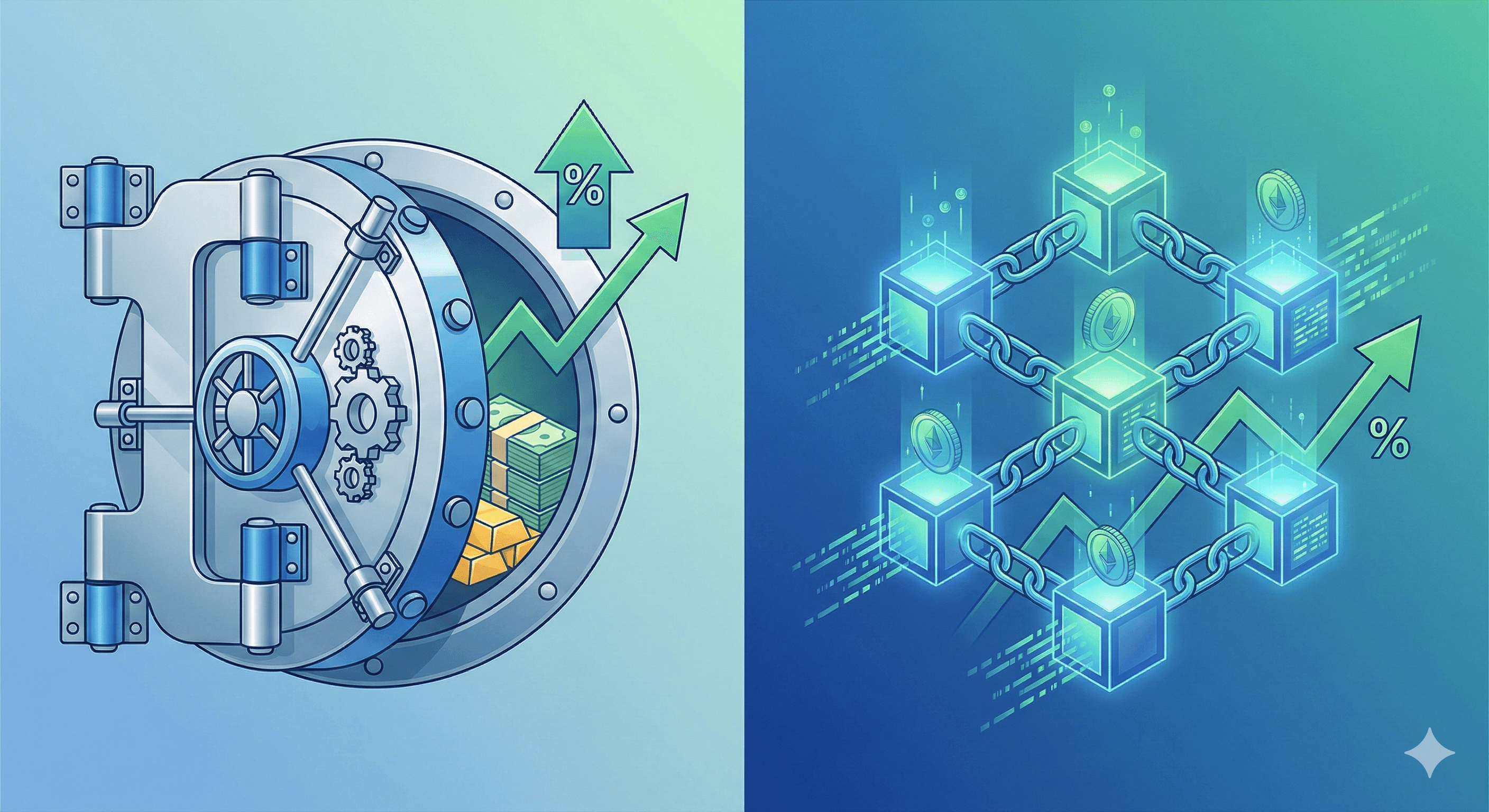
High yield savings accounts are paying 3.5-4.5% APY in 2026, with some promotional rates reaching 5% for limited balances. Traditional banks aren't your only option anymore.
Crypto staking, stablecoin lending, and tokenized treasuries now offer competitive yields with different risk profiles. This guide compares everything: the best traditional HYSAs, crypto alternatives, and which approach makes sense for your situation.
Best High Yield Savings Accounts (Traditional Banks)
Here are the top-paying bank accounts in January 2026:
Bank | APY | Minimum | FDIC Insured |
|---|---|---|---|
Varo Bank | 5.00%* | $0 | Yes |
Axos Bank | 4.31% | $0 | Yes |
Capital One 360 | 3.85% | $0 | Yes |
Marcus by Goldman Sachs | 3.65% | $0 | Yes |
Discover | 3.50% | $0 | Yes |
Ally Bank | 3.30% | $0 | Yes |
*Varo's 5.00% only applies to the first $5,000 with qualifying transactions. Balances above $5K earn a lower rate.
Varo Bank leads with 5.00% APY but requires meeting conditions (direct deposit, minimum transactions) and caps the top rate at $5,000. For larger savings, this isn't practical.
Axos Bank offers 4.31% with fewer restrictions. Better for larger balances.
Capital One 360 pays 3.85% with no hoops and strong overall banking features.
Marcus from Goldman Sachs has strong brand recognition and pays 3.65%. Their app is solid.
What to Watch
High yield savings rates track the Federal Reserve's benchmark rate. When the Fed cuts rates, HYSA yields drop. The current 3.5-4.5% environment reflects recent Fed policy.
Also note: rates are often promotional. Read the fine print. Some banks drop rates after 3-6 months or require minimum balances.
Crypto Yield Alternatives
If you're comfortable with more risk, crypto offers yield options that compete with or beat traditional savings:
Option | Typical APY | Risk Level | Liquidity |
|---|---|---|---|
USDC on Aave | 3-7% | Low-Medium | High |
Stablecoin lending (CeFi) | 3-6% | Medium-High | Variable |
ETH staking | 2-3% | Low-Medium | Variable |
Tokenized treasuries | 4-4.5% | Low-Medium | High |
Stablecoin Lending (3-7% APY)
Platforms like Aave and Compound let you lend stablecoins (USDC, USDT) to borrowers and earn interest. Rates fluctuate based on demand but often exceed bank yields.
The catch: smart contract risk. These are DeFi protocols. A bug or exploit could mean losing funds. There's no FDIC insurance.
Reputable protocols have operated for years without major incidents, but the risk is real.
Tokenized Treasuries (4-4.5% APY)
This is the bridge between traditional and crypto. Protocols like Ondo Finance offer tokens backed by actual US Treasury bills. You get Treasury yields on-chain.
The appeal: Treasury-level safety with crypto's convenience. Hold yield-bearing tokens in your wallet without dealing with brokerages.
Currently yields around 4-4.5% APY, roughly matching the underlying Treasury rate.
ETH Staking (2-3% APY)
If you want ETH exposure anyway, staking lets you earn yield on your holdings. Rates are lower than traditional savings, but you benefit if ETH appreciates.
See our complete ETH staking guide for details.
Traditional vs Crypto: Honest Comparison
Let's be real about tradeoffs.
Safety
Traditional HYSA wins. FDIC insurance covers $250,000 per depositor. If the bank fails, you get your money back. This isn't theoretical - it's happened during bank runs and the system works.
Crypto has no equivalent protection. Smart contract exploits, exchange collapses (FTX), and stablecoin depegs can result in total loss. You're taking on risks that don't exist with banks. It is important to always use high-quality, vetted platforms.
Yield
Crypto wins on raw APY. Stablecoin lending can pay 4-8% vs 3.5-4.5% from banks. It also is often self-compounding.
But risk-adjusted, the comparison is closer than it looks.
Flexibility
Mixed. Bank HYSAs offer instant transfers to your checking account. Crypto assets can be moved 24/7 without bank hours, but on-ramps and off-ramps add friction.
Taxes
Banks are simpler. You get a 1099-INT and report interest income. Done.
Crypto is a mess. Every DeFi interaction could be a taxable event. Staking rewards are taxed as income when received, then capital gains when sold. Tracking this across protocols requires software or an accountant.
Who Should Use What
Use traditional HYSA if:
You prioritize safety over maximizing yield
Your savings are your emergency fund
You want simplicity and FDIC protection
You're uncomfortable with crypto volatility or complexity
Stick with Axos or Capital One. The 0.5% yield difference between top banks isn't worth constant switching.
Use crypto yield if:
You already hold and understand crypto
You have money you can afford to lose
You're comfortable with DeFi risks
You want higher yields and accept the tradeoffs
Start with tokenized treasuries (safest) or established lending protocols like Aave. Avoid chasing the highest yields - those usually indicate hidden risks.
Use both if:
You want diversification across risk profiles
You can handle the complexity of two systems
You're building a yield ladder from safe to aggressive
A reasonable split: 70-80% in FDIC-insured HYSA, 20-30% in crypto yield. Adjust based on your risk tolerance.
Yield Optimization Strategies
For Traditional Savings
Open multiple accounts. FDIC covers $250K per depositor, per bank. If you have more than $250K, spread it across banks.
Watch for rate drops. Banks quietly lower rates. Set calendar reminders to check quarterly and switch if needed.
Don't over-optimize. The difference between 4.60% and 4.85% on $10,000 is $25 per year. Not worth constant switching.
For Crypto Yield
Use a yield aggregator. Platforms like Pistachio.fi help you find the best rates across protocols without manually checking each one.
Diversify across protocols. Don't put everything in one lending pool. Spread risk. Platforms like Pistachio offer you risk grades on high-quality vaults.
Account for gas. Ethereum transactions cost money. If you're moving small amounts frequently, fees eat your yield. Consider layer 2 networks or batch transactions. Or use Pistachio, which has no gas fees at all.
Track your taxes. Use Koinly, TokenTax, or similar from day one. Retroactive tracking is painful. Pistachio makes this easy by partnering with the best-in-class tax platforms like Awaken.Tax.
2026 Rate Outlook
Where are yields heading?
The Federal Reserve signaled potential rate cuts in late 2025, but inflation concerns have kept rates elevated into 2026. Most analysts expect:
HYSA rates to stay in the 3.5-4.5% range through mid-2026
Gradual decline to 3-3.5% by year end if cuts materialize
Crypto lending rates to follow similar patterns (they correlate loosely with traditional rates)
Lock in current rates where possible. Some banks offer CD alternatives with fixed rates if you're worried about drops.
Bottom Line
The best high yield savings account in 2026 depends on your priorities.
For pure safety: Axos Bank at 4.31% APY or Capital One 360 at 3.85% with no gimmicks.
For maximum yield with some risk: Stablecoin lending on established protocols like Aave at 4-10%.
For a bridge between worlds: Tokenized treasuries offering Treasury yields on-chain within platforms like Pistachio.
For most people, a traditional HYSA makes sense for emergency funds and near-term savings. Crypto yield is better suited for money you want to grow a bit more aggressively.
Pistachio.fi can help you compare rates across both traditional and crypto yield options, finding the right balance for your situation.
Pistachio.fi aggregates yield opportunities across DeFi and traditional finance. Compare rates and start earning today.
High yield savings accounts are paying 3.5-4.5% APY in 2026, with some promotional rates reaching 5% for limited balances. Traditional banks aren't your only option anymore.
Crypto staking, stablecoin lending, and tokenized treasuries now offer competitive yields with different risk profiles. This guide compares everything: the best traditional HYSAs, crypto alternatives, and which approach makes sense for your situation.
Best High Yield Savings Accounts (Traditional Banks)
Here are the top-paying bank accounts in January 2026:
Bank | APY | Minimum | FDIC Insured |
|---|---|---|---|
Varo Bank | 5.00%* | $0 | Yes |
Axos Bank | 4.31% | $0 | Yes |
Capital One 360 | 3.85% | $0 | Yes |
Marcus by Goldman Sachs | 3.65% | $0 | Yes |
Discover | 3.50% | $0 | Yes |
Ally Bank | 3.30% | $0 | Yes |
*Varo's 5.00% only applies to the first $5,000 with qualifying transactions. Balances above $5K earn a lower rate.
Varo Bank leads with 5.00% APY but requires meeting conditions (direct deposit, minimum transactions) and caps the top rate at $5,000. For larger savings, this isn't practical.
Axos Bank offers 4.31% with fewer restrictions. Better for larger balances.
Capital One 360 pays 3.85% with no hoops and strong overall banking features.
Marcus from Goldman Sachs has strong brand recognition and pays 3.65%. Their app is solid.
What to Watch
High yield savings rates track the Federal Reserve's benchmark rate. When the Fed cuts rates, HYSA yields drop. The current 3.5-4.5% environment reflects recent Fed policy.
Also note: rates are often promotional. Read the fine print. Some banks drop rates after 3-6 months or require minimum balances.
Crypto Yield Alternatives
If you're comfortable with more risk, crypto offers yield options that compete with or beat traditional savings:
Option | Typical APY | Risk Level | Liquidity |
|---|---|---|---|
USDC on Aave | 3-7% | Low-Medium | High |
Stablecoin lending (CeFi) | 3-6% | Medium-High | Variable |
ETH staking | 2-3% | Low-Medium | Variable |
Tokenized treasuries | 4-4.5% | Low-Medium | High |
Stablecoin Lending (3-7% APY)
Platforms like Aave and Compound let you lend stablecoins (USDC, USDT) to borrowers and earn interest. Rates fluctuate based on demand but often exceed bank yields.
The catch: smart contract risk. These are DeFi protocols. A bug or exploit could mean losing funds. There's no FDIC insurance.
Reputable protocols have operated for years without major incidents, but the risk is real.
Tokenized Treasuries (4-4.5% APY)
This is the bridge between traditional and crypto. Protocols like Ondo Finance offer tokens backed by actual US Treasury bills. You get Treasury yields on-chain.
The appeal: Treasury-level safety with crypto's convenience. Hold yield-bearing tokens in your wallet without dealing with brokerages.
Currently yields around 4-4.5% APY, roughly matching the underlying Treasury rate.
ETH Staking (2-3% APY)
If you want ETH exposure anyway, staking lets you earn yield on your holdings. Rates are lower than traditional savings, but you benefit if ETH appreciates.
See our complete ETH staking guide for details.
Traditional vs Crypto: Honest Comparison
Let's be real about tradeoffs.
Safety
Traditional HYSA wins. FDIC insurance covers $250,000 per depositor. If the bank fails, you get your money back. This isn't theoretical - it's happened during bank runs and the system works.
Crypto has no equivalent protection. Smart contract exploits, exchange collapses (FTX), and stablecoin depegs can result in total loss. You're taking on risks that don't exist with banks. It is important to always use high-quality, vetted platforms.
Yield
Crypto wins on raw APY. Stablecoin lending can pay 4-8% vs 3.5-4.5% from banks. It also is often self-compounding.
But risk-adjusted, the comparison is closer than it looks.
Flexibility
Mixed. Bank HYSAs offer instant transfers to your checking account. Crypto assets can be moved 24/7 without bank hours, but on-ramps and off-ramps add friction.
Taxes
Banks are simpler. You get a 1099-INT and report interest income. Done.
Crypto is a mess. Every DeFi interaction could be a taxable event. Staking rewards are taxed as income when received, then capital gains when sold. Tracking this across protocols requires software or an accountant.
Who Should Use What
Use traditional HYSA if:
You prioritize safety over maximizing yield
Your savings are your emergency fund
You want simplicity and FDIC protection
You're uncomfortable with crypto volatility or complexity
Stick with Axos or Capital One. The 0.5% yield difference between top banks isn't worth constant switching.
Use crypto yield if:
You already hold and understand crypto
You have money you can afford to lose
You're comfortable with DeFi risks
You want higher yields and accept the tradeoffs
Start with tokenized treasuries (safest) or established lending protocols like Aave. Avoid chasing the highest yields - those usually indicate hidden risks.
Use both if:
You want diversification across risk profiles
You can handle the complexity of two systems
You're building a yield ladder from safe to aggressive
A reasonable split: 70-80% in FDIC-insured HYSA, 20-30% in crypto yield. Adjust based on your risk tolerance.
Yield Optimization Strategies
For Traditional Savings
Open multiple accounts. FDIC covers $250K per depositor, per bank. If you have more than $250K, spread it across banks.
Watch for rate drops. Banks quietly lower rates. Set calendar reminders to check quarterly and switch if needed.
Don't over-optimize. The difference between 4.60% and 4.85% on $10,000 is $25 per year. Not worth constant switching.
For Crypto Yield
Use a yield aggregator. Platforms like Pistachio.fi help you find the best rates across protocols without manually checking each one.
Diversify across protocols. Don't put everything in one lending pool. Spread risk. Platforms like Pistachio offer you risk grades on high-quality vaults.
Account for gas. Ethereum transactions cost money. If you're moving small amounts frequently, fees eat your yield. Consider layer 2 networks or batch transactions. Or use Pistachio, which has no gas fees at all.
Track your taxes. Use Koinly, TokenTax, or similar from day one. Retroactive tracking is painful. Pistachio makes this easy by partnering with the best-in-class tax platforms like Awaken.Tax.
2026 Rate Outlook
Where are yields heading?
The Federal Reserve signaled potential rate cuts in late 2025, but inflation concerns have kept rates elevated into 2026. Most analysts expect:
HYSA rates to stay in the 3.5-4.5% range through mid-2026
Gradual decline to 3-3.5% by year end if cuts materialize
Crypto lending rates to follow similar patterns (they correlate loosely with traditional rates)
Lock in current rates where possible. Some banks offer CD alternatives with fixed rates if you're worried about drops.
Bottom Line
The best high yield savings account in 2026 depends on your priorities.
For pure safety: Axos Bank at 4.31% APY or Capital One 360 at 3.85% with no gimmicks.
For maximum yield with some risk: Stablecoin lending on established protocols like Aave at 4-10%.
For a bridge between worlds: Tokenized treasuries offering Treasury yields on-chain within platforms like Pistachio.
For most people, a traditional HYSA makes sense for emergency funds and near-term savings. Crypto yield is better suited for money you want to grow a bit more aggressively.
Pistachio.fi can help you compare rates across both traditional and crypto yield options, finding the right balance for your situation.
Pistachio.fi aggregates yield opportunities across DeFi and traditional finance. Compare rates and start earning today.

Cross-chain crypto swaps: how Li.Fi powers Pistachio's one-tap zaps (2026)

Etherfuse stablebonds: earn government bond yields on-chain (2026)
How to earn money online in 2026 (crypto yield vs. the rest)
Linea crypto explained: what it is and how it works (2026)

Ethereum wallet guide 2026 (ethernet wallet explained)
DeFi Staking with Stader Labs: How ETHx Works in 2026

High-liquidity crypto exchanges: PancakeSwap guide 2026

What is Raydium? How Solana's AMM Works in 2026
Passive Income Ideas for 2026: 10 Ways That Actually Work

Hong Kong crypto news 2026: licenses, stablecoins, and regulation
©2026 Copyright, PistachioFi Inc.
©2026 Copyright, PistachioFi Inc.
©2026 Copyright, PistachioFi Inc.