USDC Yield 2026: Complete Guide to Morpho, Pendle & DeFi Returns
USDC Yield 2026: Complete Guide to Morpho, Pendle & DeFi Returns

USDC Yield 2026: Complete Guide to Morpho, Pendle & DeFi Returns
USDC Yield 2026: Complete Guide to Morpho, Pendle & DeFi Returns
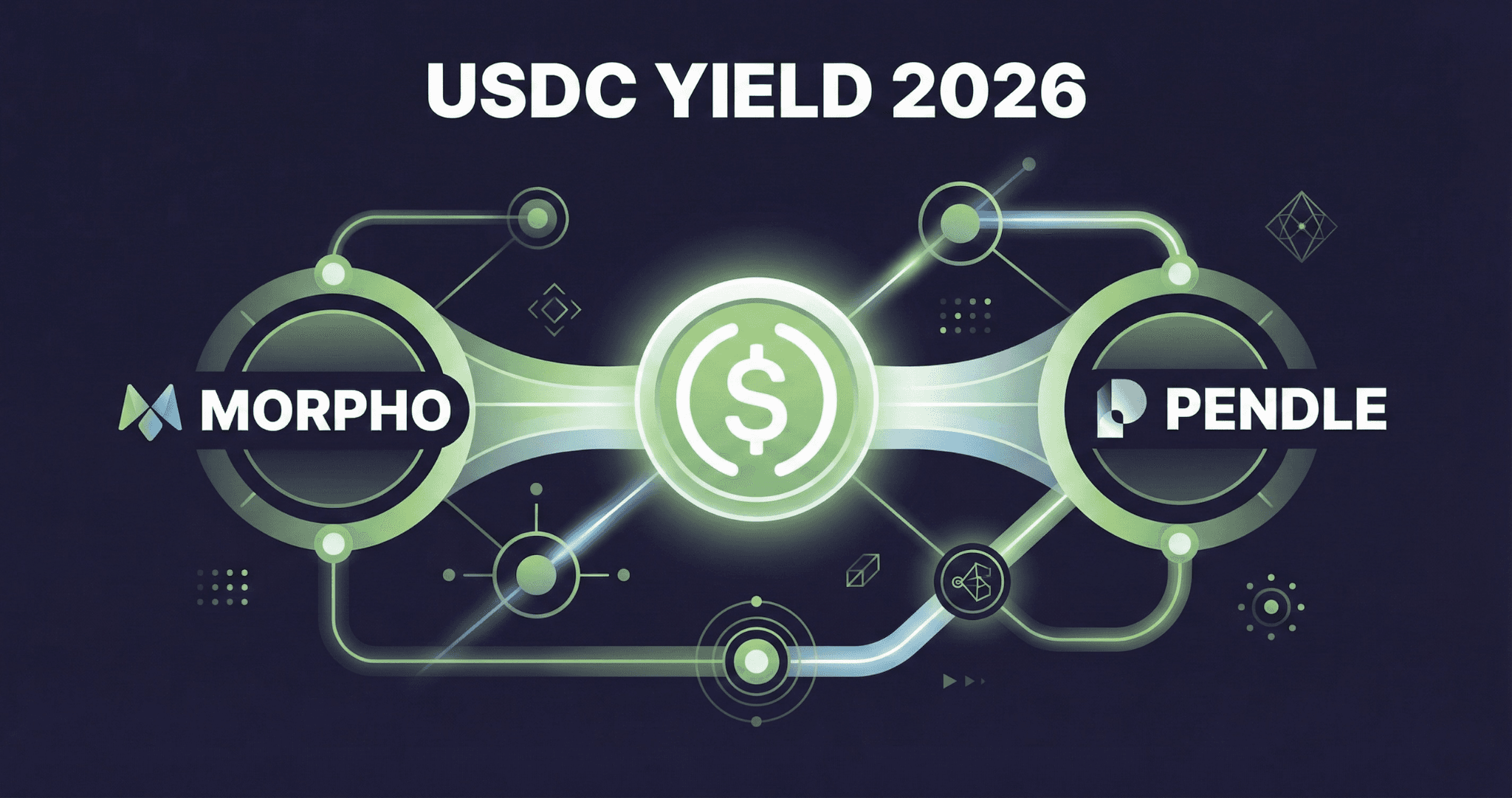
The USDC yield landscape has transformed heading into 2026. Traditional savings accounts still offer underwhelming returns, and centralized exchanges face increased scrutiny. Crypto-native investors are turning to DeFi protocols like Morpho and Pendle to maximize their stablecoin earnings. Whether you want conservative USDC staking options or advanced yield tokenization strategies, understanding the full spectrum of opportunities matters more than ever.
Key takeaways
USDC yield rates in 2026 range from 3-5% on CeFi platforms to 8-15%+ on optimized DeFi protocols like Morpho
Morpho USDC yield offers enhanced lending returns by matching lenders directly with borrowers, often exceeding Aave/Compound rates by 1-3%
Pendle yield tokenization allows you to lock in fixed rates or speculate on variable yields, providing flexibility unavailable elsewhere
Smart risk management through expert-graded vaults can help capture higher yields while maintaining appropriate safety margins
Gasless transactions and tax integration have become essential features for serious yield farmers
Why is USDC yield optimization more important than ever in 2026?
The stablecoin market has matured, with USDC now the go-to dollar-pegged asset for yield-seeking investors. But with maturity comes complexity. The days of simply depositing USDC on a lending platform and forgetting about it are over. Today's best USDC yield rates require active management, protocol knowledge, and smart risk assessment.
Several factors drive this evolution. Regulatory clarity in major markets has legitimized DeFi lending while simultaneously pushing some centralized players to reduce rates. Meanwhile, innovations in protocol design from teams like Morpho and Pendle have created new yield opportunities that didn't exist two years ago.
For investors holding significant USDC positions, the difference between a 4% yield and a 10% yield compounds dramatically over time. On a $100,000 position, that spread represents an additional $6,000 annually. That justifies the effort of understanding these protocols deeply.
What are the current USDC interest rates across different platforms?
Before diving into specific protocols, let's establish a baseline understanding of where USDC interest rates stand across the ecosystem. The variance is significant, reflecting different risk profiles, lockup requirements, and underlying mechanisms.
Platform type | APY range | Risk level | Key features |
|---|---|---|---|
CeFi exchanges (Coinbase, Kraken) | 3.0% - 5.5% | Low-Medium | Custodial, insured deposits, regulatory compliance |
Traditional DeFi (Aave, Compound) | 4.0% - 7.0% | Medium | Battle-tested, liquid markets, variable rates |
Morpho optimized (Morpho Blue) | 6.5% - 12.0% | Medium | P2P matching, higher efficiency, curated markets |
Pendle fixed (PT tokens) | 7.0% - 11.0% | Medium | Fixed rates, known returns, date-locked |
Pendle variable (YT tokens) | 10.0% - 25.0%+ | Higher | Yield speculation, leveraged exposure, volatile |
Curated vaults (Pistachio.fi) | 6.0% - 14.0% | Graded | Expert curation, risk grades, gasless UX |
How does Morpho USDC yield work?
Morpho has become one of the most interesting protocols for USDC lending in 2026. Originally launched as an optimization layer on top of Aave and Compound, Morpho has evolved into Morpho Blue, a standalone lending protocol capturing significant market share.
The Morpho advantage
Traditional lending protocols like Aave use a pool-based model where all lenders share returns based on aggregate utilization. This creates inefficiencies. Your funds might be sitting idle in an underutilized pool, earning less than optimal rates.
Morpho takes a different approach. The protocol attempts to match lenders directly with borrowers at rates that benefit both parties. When a perfect match isn't available, funds fall back to the underlying pool mechanism. This dual approach means Morpho USDC yield consistently outperforms base protocol rates, often by 1-3 percentage points.
Morpho Blue: the next evolution
Morpho Blue introduced permissionless market creation, allowing anyone to spin up lending markets with custom parameters. For USDC lenders, this means access to specialized markets with higher yields, though these require more careful evaluation. Key considerations include:
Collateral quality: Markets backed by liquid, stable collateral carry lower risk
Liquidation parameters: Higher LTV markets offer better rates but increased exposure
Oracle reliability: Price feed quality directly impacts liquidation effectiveness
Market curator reputation: Established curators like Gauntlet or Steakhouse provide additional security
Pro tip: Rather than navigating the complexity of individual Morpho markets yourself, platforms like Pistachio.fi aggregate the best opportunities with expert risk grades. This saves time while ensuring you're not accidentally exposing yourself to poorly designed markets.
What makes Pendle yield different from traditional DeFi?
Pendle changed how we think about DeFi yield by introducing yield tokenization. Instead of earning variable rates that fluctuate daily, Pendle lets you separate yield-bearing assets into two components: Principal Tokens (PT) and Yield Tokens (YT).
Understanding principal tokens (PT) for fixed USDC yield
When you purchase a PT, you're buying the right to receive the underlying asset at a future maturity date. For USDC-denominated positions, this means you can lock in a fixed rate today, regardless of what happens to market rates tomorrow.
For example, if PT-stUSDC is trading at a 9% implied APY with 6 months to maturity, you know exactly what you'll earn. This predictability is invaluable for treasury management, fixed-income strategies, or simply removing rate volatility from your portfolio.
Yield tokens (YT): speculating on future rates
YT tokens represent the opposite side of the equation: the variable yield stream separated from the principal. Buying YT is essentially a leveraged bet that future yields will exceed current implied rates. If you believe USDC staking rates will spike due to market conditions, YT exposure amplifies your returns.
However, YT positions carry significant risk. If yields underperform expectations, YT tokens can lose substantial value as they approach maturity. This is not a strategy for beginners, but sophisticated yield farmers use YT to express directional views on the rate market.
Pendle yield strategies for 2026
The Pendle ecosystem has expanded, with USDC-based pools across multiple yield sources including:
sDAI/sUSDC pools: Tokenized savings rate exposure
Morpho PT pools: Fixed rates on optimized lending positions
Ethena sUSDe pools: Higher yields with synthetic dollar exposure
Aave/Compound PT pools: Reliable fixed rates on established protocols
How do traditional DeFi platforms compare for USDC staking?
While Morpho and Pendle are the cutting edge, traditional DeFi lending platforms remain relevant. Aave and Compound have the longest track records, the deepest liquidity, and the most battle-tested smart contracts in the space.
Aave V3: the incumbent champion
Aave continues to dominate DeFi lending by TVL. USDC interest rates on Aave typically range from 4-7% depending on market conditions and chain deployment. The protocol's efficiency mode (E-mode) can boost rates in certain configurations, and multi-chain deployment means you can shop for the best rates across Ethereum, Arbitrum, Optimism, and other networks.
Compound V3: simplified but effective
Compound's V3 redesign focused the protocol specifically on USDC as the base asset. This simplification improved capital efficiency and often results in competitive rates. For investors who prefer a stripped-down, focused approach, Compound V3 remains a solid choice.
What about CeFi options for USDC yield?
Centralized exchanges still serve an important role, particularly for investors who prioritize convenience and regulatory protection over maximum yields. Coinbase's USDC rewards program offers around 4-5% APY with the benefit of FDIC-style protections and seamless integration with traditional banking.
However, CeFi rates consistently lag DeFi alternatives. The trade-off is clear: accept lower yields for reduced complexity and counterparty transparency, or venture into DeFi for higher returns with smart contract risk. Many sophisticated investors split their USDC allocation across both categories based on their risk tolerance and liquidity needs.
How should you evaluate USDC yield opportunities?
With so many options available, you need a framework for evaluation. Here are the factors to consider:
1. Risk-adjusted returns
A 15% yield means nothing if it comes with a 10% chance of total loss. Smart yield farming requires evaluating the probability-weighted outcome, not just the headline APY. Risk grades condense complex protocol analysis into actionable ratings.
2. Liquidity and lock-up terms
Pendle PT positions have fixed maturities. Morpho markets may have varying withdrawal liquidity. Understanding your exit options before entering any position prevents painful surprises when you need funds quickly.
3. Gas costs and transaction friction
On Ethereum mainnet, gas costs can eat into yields for smaller positions. This makes gasless transaction solutions attractive. Platforms that batch transactions or subsidize gas can meaningfully improve net returns.
4. Tax implications
Yield farming creates taxable events. Without proper tracking, tax season becomes a nightmare of transaction reconciliation. Integration with tools like Awaken.Tax isn't just convenient. It's essential for serious yield farmers who want to stay compliant without spending hours on spreadsheets.
Maximize your USDC yield with Pistachio.fi
Stop navigating complex protocols alone. Pistachio.fi's curated investment vaults bring you the best USDC yield opportunities from Morpho, Pendle, and more. Complete with expert risk grades, gasless transactions, and seamless Awaken.Tax integration.
Start earning smarter yields →
Building your 2026 USDC yield strategy
The optimal approach for most investors involves diversification across yield sources and risk levels. Consider a framework like:
Conservative tier (40-50%): CeFi platforms or Aave/Compound for maximum stability
Optimized tier (30-40%): Morpho curated markets for enhanced returns with managed risk
Opportunistic tier (10-20%): Pendle PT positions for fixed rates or selective YT exposure
This structure balances yield optimization with prudent risk management. Adjust percentages based on your personal risk tolerance, investment horizon, and liquidity needs.
Frequently asked questions
What is the safest way to earn yield on USDC in 2026?
The safest options remain centralized platforms like Coinbase (4-5% APY) or battle-tested DeFi protocols like Aave and Compound (4-7% APY). For those willing to accept slightly more complexity, curated Morpho markets with expert risk grades offer a strong balance of enhanced yields (6-12% APY) with managed risk exposure.
How does Pendle's fixed yield actually work?
Pendle separates yield-bearing assets into Principal Tokens (PT) and Yield Tokens (YT). When you buy PT, you're purchasing the right to the underlying asset at maturity. The discount you pay today versus the face value at maturity represents your locked-in yield. This creates truly fixed returns regardless of rate fluctuations, making it powerful for predictable income strategies.
Is Morpho USDC yield sustainable or just temporary high rates?
Morpho's enhanced yields stem from genuine efficiency improvements. Peer-to-peer matching eliminates the spread lost in pool-based systems. While rates fluctuate with market conditions, the structural advantage persists. That said, always verify current rates before depositing, as crypto markets can shift quickly.
What are the main risks of DeFi USDC yield strategies?
Key risks include smart contract vulnerabilities, oracle failures, collateral liquidation cascades, and regulatory changes. Additionally, some higher-yield opportunities involve exposure to synthetic or algorithmic stablecoins with their own risk profiles. Proper diversification and using platforms with expert risk curation helps manage these exposures.
How do gas costs affect USDC yield farming returns?
On Ethereum mainnet, gas costs can significantly impact smaller positions. A $50 transaction fee on a $5,000 deposit earning 8% APY would take over two months just to break even on gas. This is why gasless transaction platforms and Layer 2 deployments have become increasingly popular for yield farmers optimizing net returns.
Conclusion: optimizing your USDC yield in 2026
Opportunities for earning meaningful yield on USDC have never been more diverse. From the safety of CeFi platforms to the enhanced returns of Morpho and Pendle's yield tokenization, investors can construct portfolios tailored to their risk-return preferences.
The key is approaching these opportunities with clear-eyed risk assessment and proper tools. Platforms that combine curated vault selection, expert risk grading, gasless transactions, and integrated tax reporting remove friction from the yield optimization process. That lets you focus on returns rather than operational complexity.
Related reading
Disclaimer: This article is for informational purposes only and does not constitute financial advice. Cryptocurrency investments carry significant risks including potential loss of principal. Past performance does not guarantee future results. Always conduct your own research and consider consulting a financial advisor before making investment decisions.
The USDC yield landscape has transformed heading into 2026. Traditional savings accounts still offer underwhelming returns, and centralized exchanges face increased scrutiny. Crypto-native investors are turning to DeFi protocols like Morpho and Pendle to maximize their stablecoin earnings. Whether you want conservative USDC staking options or advanced yield tokenization strategies, understanding the full spectrum of opportunities matters more than ever.
Key takeaways
USDC yield rates in 2026 range from 3-5% on CeFi platforms to 8-15%+ on optimized DeFi protocols like Morpho
Morpho USDC yield offers enhanced lending returns by matching lenders directly with borrowers, often exceeding Aave/Compound rates by 1-3%
Pendle yield tokenization allows you to lock in fixed rates or speculate on variable yields, providing flexibility unavailable elsewhere
Smart risk management through expert-graded vaults can help capture higher yields while maintaining appropriate safety margins
Gasless transactions and tax integration have become essential features for serious yield farmers
Why is USDC yield optimization more important than ever in 2026?
The stablecoin market has matured, with USDC now the go-to dollar-pegged asset for yield-seeking investors. But with maturity comes complexity. The days of simply depositing USDC on a lending platform and forgetting about it are over. Today's best USDC yield rates require active management, protocol knowledge, and smart risk assessment.
Several factors drive this evolution. Regulatory clarity in major markets has legitimized DeFi lending while simultaneously pushing some centralized players to reduce rates. Meanwhile, innovations in protocol design from teams like Morpho and Pendle have created new yield opportunities that didn't exist two years ago.
For investors holding significant USDC positions, the difference between a 4% yield and a 10% yield compounds dramatically over time. On a $100,000 position, that spread represents an additional $6,000 annually. That justifies the effort of understanding these protocols deeply.
What are the current USDC interest rates across different platforms?
Before diving into specific protocols, let's establish a baseline understanding of where USDC interest rates stand across the ecosystem. The variance is significant, reflecting different risk profiles, lockup requirements, and underlying mechanisms.
Platform type | APY range | Risk level | Key features |
|---|---|---|---|
CeFi exchanges (Coinbase, Kraken) | 3.0% - 5.5% | Low-Medium | Custodial, insured deposits, regulatory compliance |
Traditional DeFi (Aave, Compound) | 4.0% - 7.0% | Medium | Battle-tested, liquid markets, variable rates |
Morpho optimized (Morpho Blue) | 6.5% - 12.0% | Medium | P2P matching, higher efficiency, curated markets |
Pendle fixed (PT tokens) | 7.0% - 11.0% | Medium | Fixed rates, known returns, date-locked |
Pendle variable (YT tokens) | 10.0% - 25.0%+ | Higher | Yield speculation, leveraged exposure, volatile |
Curated vaults (Pistachio.fi) | 6.0% - 14.0% | Graded | Expert curation, risk grades, gasless UX |
How does Morpho USDC yield work?
Morpho has become one of the most interesting protocols for USDC lending in 2026. Originally launched as an optimization layer on top of Aave and Compound, Morpho has evolved into Morpho Blue, a standalone lending protocol capturing significant market share.
The Morpho advantage
Traditional lending protocols like Aave use a pool-based model where all lenders share returns based on aggregate utilization. This creates inefficiencies. Your funds might be sitting idle in an underutilized pool, earning less than optimal rates.
Morpho takes a different approach. The protocol attempts to match lenders directly with borrowers at rates that benefit both parties. When a perfect match isn't available, funds fall back to the underlying pool mechanism. This dual approach means Morpho USDC yield consistently outperforms base protocol rates, often by 1-3 percentage points.
Morpho Blue: the next evolution
Morpho Blue introduced permissionless market creation, allowing anyone to spin up lending markets with custom parameters. For USDC lenders, this means access to specialized markets with higher yields, though these require more careful evaluation. Key considerations include:
Collateral quality: Markets backed by liquid, stable collateral carry lower risk
Liquidation parameters: Higher LTV markets offer better rates but increased exposure
Oracle reliability: Price feed quality directly impacts liquidation effectiveness
Market curator reputation: Established curators like Gauntlet or Steakhouse provide additional security
Pro tip: Rather than navigating the complexity of individual Morpho markets yourself, platforms like Pistachio.fi aggregate the best opportunities with expert risk grades. This saves time while ensuring you're not accidentally exposing yourself to poorly designed markets.
What makes Pendle yield different from traditional DeFi?
Pendle changed how we think about DeFi yield by introducing yield tokenization. Instead of earning variable rates that fluctuate daily, Pendle lets you separate yield-bearing assets into two components: Principal Tokens (PT) and Yield Tokens (YT).
Understanding principal tokens (PT) for fixed USDC yield
When you purchase a PT, you're buying the right to receive the underlying asset at a future maturity date. For USDC-denominated positions, this means you can lock in a fixed rate today, regardless of what happens to market rates tomorrow.
For example, if PT-stUSDC is trading at a 9% implied APY with 6 months to maturity, you know exactly what you'll earn. This predictability is invaluable for treasury management, fixed-income strategies, or simply removing rate volatility from your portfolio.
Yield tokens (YT): speculating on future rates
YT tokens represent the opposite side of the equation: the variable yield stream separated from the principal. Buying YT is essentially a leveraged bet that future yields will exceed current implied rates. If you believe USDC staking rates will spike due to market conditions, YT exposure amplifies your returns.
However, YT positions carry significant risk. If yields underperform expectations, YT tokens can lose substantial value as they approach maturity. This is not a strategy for beginners, but sophisticated yield farmers use YT to express directional views on the rate market.
Pendle yield strategies for 2026
The Pendle ecosystem has expanded, with USDC-based pools across multiple yield sources including:
sDAI/sUSDC pools: Tokenized savings rate exposure
Morpho PT pools: Fixed rates on optimized lending positions
Ethena sUSDe pools: Higher yields with synthetic dollar exposure
Aave/Compound PT pools: Reliable fixed rates on established protocols
How do traditional DeFi platforms compare for USDC staking?
While Morpho and Pendle are the cutting edge, traditional DeFi lending platforms remain relevant. Aave and Compound have the longest track records, the deepest liquidity, and the most battle-tested smart contracts in the space.
Aave V3: the incumbent champion
Aave continues to dominate DeFi lending by TVL. USDC interest rates on Aave typically range from 4-7% depending on market conditions and chain deployment. The protocol's efficiency mode (E-mode) can boost rates in certain configurations, and multi-chain deployment means you can shop for the best rates across Ethereum, Arbitrum, Optimism, and other networks.
Compound V3: simplified but effective
Compound's V3 redesign focused the protocol specifically on USDC as the base asset. This simplification improved capital efficiency and often results in competitive rates. For investors who prefer a stripped-down, focused approach, Compound V3 remains a solid choice.
What about CeFi options for USDC yield?
Centralized exchanges still serve an important role, particularly for investors who prioritize convenience and regulatory protection over maximum yields. Coinbase's USDC rewards program offers around 4-5% APY with the benefit of FDIC-style protections and seamless integration with traditional banking.
However, CeFi rates consistently lag DeFi alternatives. The trade-off is clear: accept lower yields for reduced complexity and counterparty transparency, or venture into DeFi for higher returns with smart contract risk. Many sophisticated investors split their USDC allocation across both categories based on their risk tolerance and liquidity needs.
How should you evaluate USDC yield opportunities?
With so many options available, you need a framework for evaluation. Here are the factors to consider:
1. Risk-adjusted returns
A 15% yield means nothing if it comes with a 10% chance of total loss. Smart yield farming requires evaluating the probability-weighted outcome, not just the headline APY. Risk grades condense complex protocol analysis into actionable ratings.
2. Liquidity and lock-up terms
Pendle PT positions have fixed maturities. Morpho markets may have varying withdrawal liquidity. Understanding your exit options before entering any position prevents painful surprises when you need funds quickly.
3. Gas costs and transaction friction
On Ethereum mainnet, gas costs can eat into yields for smaller positions. This makes gasless transaction solutions attractive. Platforms that batch transactions or subsidize gas can meaningfully improve net returns.
4. Tax implications
Yield farming creates taxable events. Without proper tracking, tax season becomes a nightmare of transaction reconciliation. Integration with tools like Awaken.Tax isn't just convenient. It's essential for serious yield farmers who want to stay compliant without spending hours on spreadsheets.
Maximize your USDC yield with Pistachio.fi
Stop navigating complex protocols alone. Pistachio.fi's curated investment vaults bring you the best USDC yield opportunities from Morpho, Pendle, and more. Complete with expert risk grades, gasless transactions, and seamless Awaken.Tax integration.
Start earning smarter yields →
Building your 2026 USDC yield strategy
The optimal approach for most investors involves diversification across yield sources and risk levels. Consider a framework like:
Conservative tier (40-50%): CeFi platforms or Aave/Compound for maximum stability
Optimized tier (30-40%): Morpho curated markets for enhanced returns with managed risk
Opportunistic tier (10-20%): Pendle PT positions for fixed rates or selective YT exposure
This structure balances yield optimization with prudent risk management. Adjust percentages based on your personal risk tolerance, investment horizon, and liquidity needs.
Frequently asked questions
What is the safest way to earn yield on USDC in 2026?
The safest options remain centralized platforms like Coinbase (4-5% APY) or battle-tested DeFi protocols like Aave and Compound (4-7% APY). For those willing to accept slightly more complexity, curated Morpho markets with expert risk grades offer a strong balance of enhanced yields (6-12% APY) with managed risk exposure.
How does Pendle's fixed yield actually work?
Pendle separates yield-bearing assets into Principal Tokens (PT) and Yield Tokens (YT). When you buy PT, you're purchasing the right to the underlying asset at maturity. The discount you pay today versus the face value at maturity represents your locked-in yield. This creates truly fixed returns regardless of rate fluctuations, making it powerful for predictable income strategies.
Is Morpho USDC yield sustainable or just temporary high rates?
Morpho's enhanced yields stem from genuine efficiency improvements. Peer-to-peer matching eliminates the spread lost in pool-based systems. While rates fluctuate with market conditions, the structural advantage persists. That said, always verify current rates before depositing, as crypto markets can shift quickly.
What are the main risks of DeFi USDC yield strategies?
Key risks include smart contract vulnerabilities, oracle failures, collateral liquidation cascades, and regulatory changes. Additionally, some higher-yield opportunities involve exposure to synthetic or algorithmic stablecoins with their own risk profiles. Proper diversification and using platforms with expert risk curation helps manage these exposures.
How do gas costs affect USDC yield farming returns?
On Ethereum mainnet, gas costs can significantly impact smaller positions. A $50 transaction fee on a $5,000 deposit earning 8% APY would take over two months just to break even on gas. This is why gasless transaction platforms and Layer 2 deployments have become increasingly popular for yield farmers optimizing net returns.
Conclusion: optimizing your USDC yield in 2026
Opportunities for earning meaningful yield on USDC have never been more diverse. From the safety of CeFi platforms to the enhanced returns of Morpho and Pendle's yield tokenization, investors can construct portfolios tailored to their risk-return preferences.
The key is approaching these opportunities with clear-eyed risk assessment and proper tools. Platforms that combine curated vault selection, expert risk grading, gasless transactions, and integrated tax reporting remove friction from the yield optimization process. That lets you focus on returns rather than operational complexity.
Related reading
Disclaimer: This article is for informational purposes only and does not constitute financial advice. Cryptocurrency investments carry significant risks including potential loss of principal. Past performance does not guarantee future results. Always conduct your own research and consider consulting a financial advisor before making investment decisions.

Cross-chain crypto swaps: how Li.Fi powers Pistachio's one-tap zaps (2026)

Etherfuse stablebonds: earn government bond yields on-chain (2026)
How to earn money online in 2026 (crypto yield vs. the rest)
Linea crypto explained: what it is and how it works (2026)

Ethereum wallet guide 2026 (ethernet wallet explained)
DeFi Staking with Stader Labs: How ETHx Works in 2026

High-liquidity crypto exchanges: PancakeSwap guide 2026
What is Raydium? How Solana's AMM Works in 2026
Passive Income Ideas for 2026: 10 Ways That Actually Work

Hong Kong crypto news 2026: licenses, stablecoins, and regulation
©2026 Copyright, PistachioFi Inc.
©2026 Copyright, PistachioFi Inc.
©2026 Copyright, PistachioFi Inc.